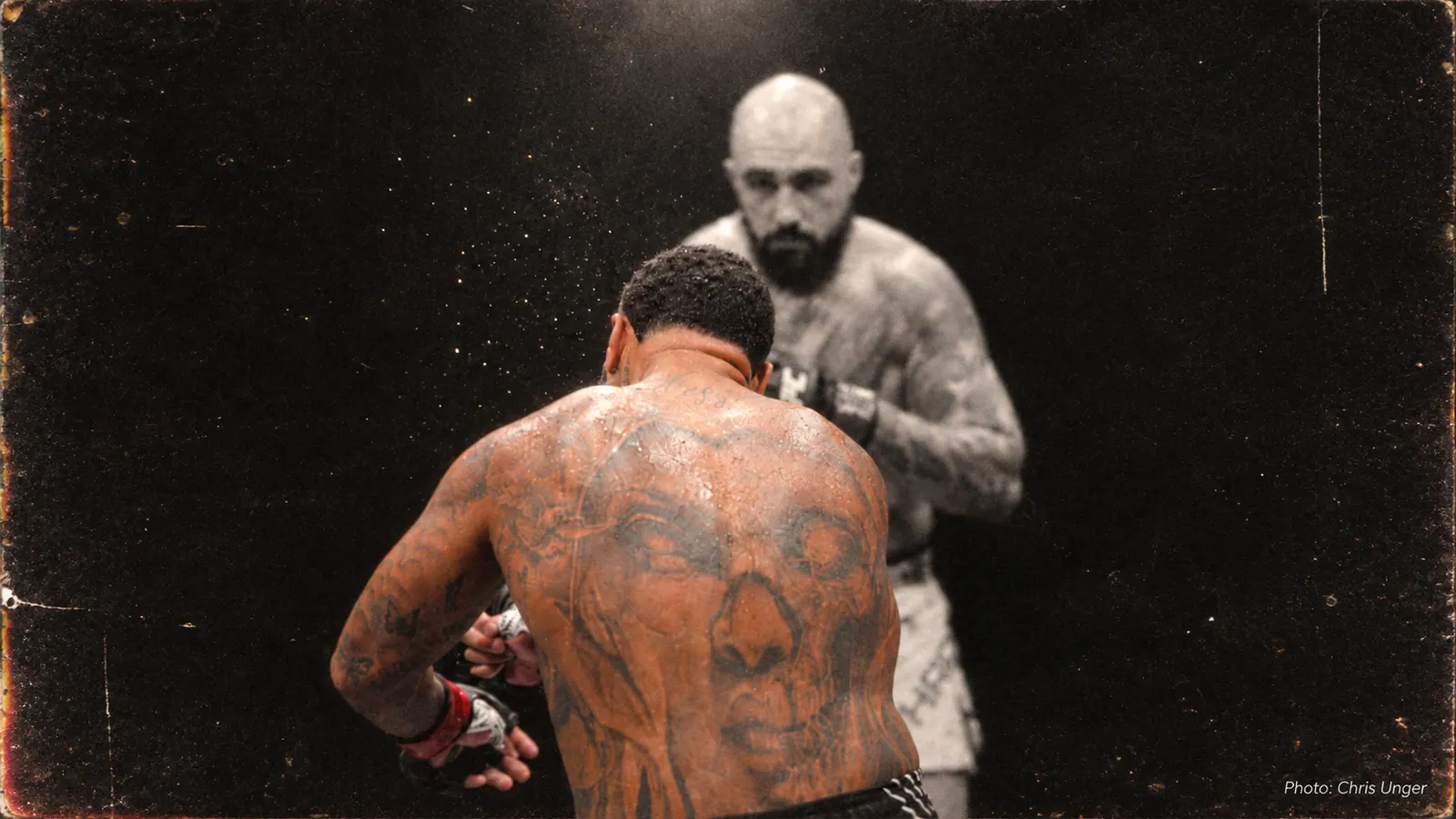
Every once in a while, MMA delivers in the most satisfying way possible: the bad guy gets completely decimated.
I’d like to say the decimation was delivered by a good guy, but this sport will teach you not to judge people too quickly.
From what we know so far, Sean Sharaf appears to be one of the good guys. He’s a U.S. Marine, talks about wanting to help support his mother in retirement, and is proud of his Palestinian descent.
He is, however, in substantial debt, although exactly how he got there hasn’t been particularly well reported. Some suspicions about it being related to automobiles and maybe gambling debt. That doesn’t make someone a bad person.
For now, though, even if this ultimately becomes only a small but significant moment in his career, Sharaf gets to be the good guy.
For Gable Steveson, he’s the heel. Given his background, he’s almost forced into that role.
Sean Sharaf called it out directly during the pre-fight press conference in a bold and rather brilliant move.
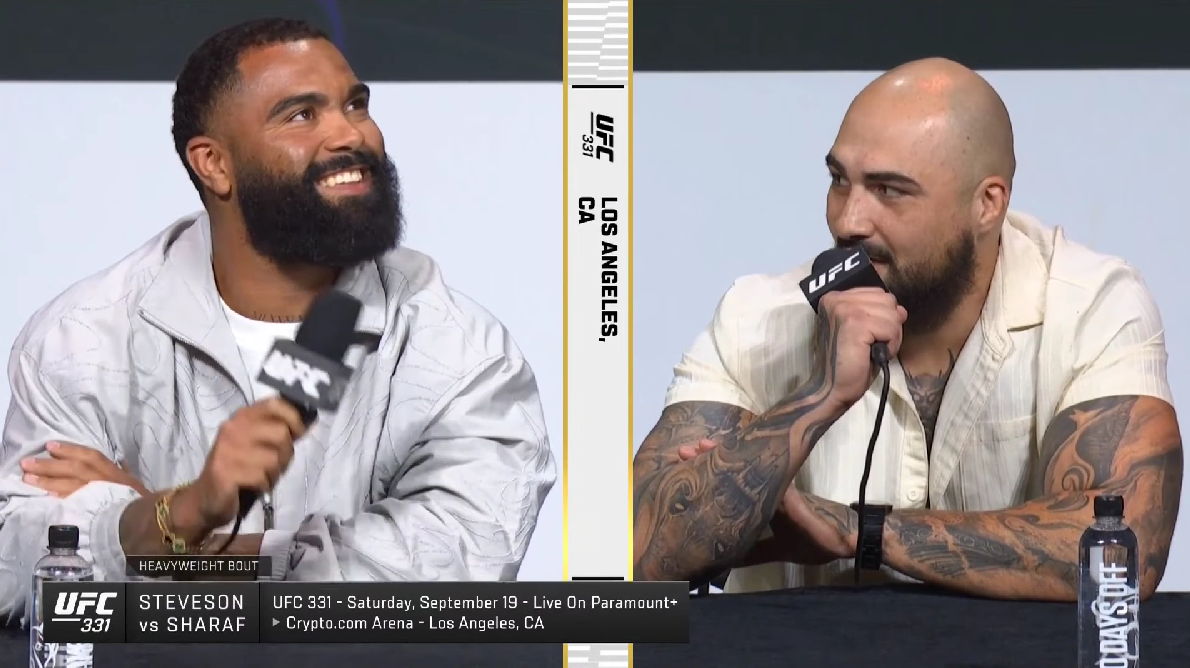
“This guy raped a woman in 2019, and that’s why everyone’s booing him. You can’t do that shit. It’s wrong.”
For those unfamiliar with Gable’s story, here are the details.
The 2019 Gable Steveson Investigation
In June 2019, the Hennepin County Attorney’s Office said it had reviewed criminal sexual conduct allegations against University of Minnesota wrestlers Gable Steveson and Dylan Martinez.1
On June 18, the office announced that no charges could be brought at that time and that Steveson and Martinez had been released as the 36-hour period during which they could be held without charges was set to expire.1 Prosecutors said the investigation remained active and that they would continue working with Minneapolis police and reviewing additional evidence.1
In its final announcement on December 20, 2019, the Hennepin County Attorney’s Office said the Minneapolis Police Department’s Sex Crimes Unit had conducted a “thorough and complete investigation” into events that occurred on June 15.2
The office said the case was reviewed by two veteran prosecutors who specialized in sexual-assault cases, as well as senior leadership of the Hennepin County Attorney’s Office.2
After that review, the office declined to file charges against Steveson or Martinez.2 County Attorney Mike Freeman said there were conflicting versions of what happened and concluded that there was “inadequate evidence to fairly charge and prosecute this case.”2
Freeman also said Minnesota’s laws concerning intoxication and a person’s ability to consent restricted how his office could charge the case.3
At the time, Minnesota law stated that a person who was mentally incapacitated or physically helpless could not consent to a sexual act.4 The statute’s definition of “mentally incapacitated” in cases involving alcohol or other substances required that the substance had been administered without the person’s agreement.4
The same law separately defined a “physically helpless” person to include someone who was asleep or unconscious, unable to withhold or withdraw consent because of a physical condition, or unable to communicate nonconsent under the circumstances described by the statute.4
Minnesota later amended the definition of “mentally incapacitated” in 2021, adding circumstances in which a person is under the influence of a substance to such a degree that the person is incapable of consenting or of appreciating, understanding or controlling their conduct.5 That amendment took effect September 15, 2021.5
- Hennepin County Attorney’s Office, “No charges against UM wrestlers, investigation continues,” June 18, 2019. The office identified Steveson and Martinez by name, confirmed its review of criminal sexual conduct allegations, stated that their 36-hour detention period was expiring, and said the investigation remained active. Official source ↩
- Hennepin County Attorney’s Office, “No charges filed against University of Minnesota wrestlers following criminal sexual assault investigation,” Dec. 20, 2019. The office stated that Minneapolis Police’s Sex Crimes Unit conducted the investigation, described the prosecutorial review, confirmed that no charges were filed, and published Freeman’s explanation that conflicting accounts and inadequate evidence prevented a fair prosecution. Official source ↩
- Hennepin County Attorney’s Office, Dec. 20, 2019. In the same official announcement, the office stated that Minnesota’s laws concerning intoxication and a victim’s ability to give consent restricted how prosecutors could charge the case. Official source ↩
- Minnesota Revisor of Statutes, Minnesota Statutes 2018 § 609.341, subdivisions 4, 7 and 9. These provisions contain the definitions of consent, mental incapacitation and physical helplessness that were in effect when the June 2019 events occurred. Official statute ↩
- Minnesota Laws 2021, First Special Session, Chapter 11, Article 4, Section 7. The Legislature amended § 609.341, subdivision 7, to add a second definition of mental incapacitation based on the degree of a person’s intoxication. The law states that the amendment became effective Sept. 15, 2021. Official session law ↩
Steveson is legally presumed innocent, but fighting is a promotional business built around conflict, and good versus evil is about as old as promotion itself.
It also doesn’t help Steveson’s public image that he decided to align himself so closely with Jon Jones.
You’d think a quick temperature check and Google search of Jon Jones would at least make someone reconsider whether that was the best public-facing relationship to build. Jones has spent years surrounded by controversy, failed drug tests, legal trouble, public incidents involving drugs and alcohol, and repeated attempts to present a very different version of himself afterward.
He also strikes me as someone with an immense ego who has always operated largely in his own lane. So when I think about Jon Jones as a coach, I immediately wonder what that actually looks like.
If only I could sit down with Greg Jackson off the record and hear his completely unfiltered thoughts. Or just be a fly on the wall.
Because before thinking about Jon Jones as a coach, it’s worth looking at Jon Jones as a fighter who was coached.
Jon Jones Under Jackson-Wink
Jon Jones arrived at Greg Jackson’s Albuquerque camp as a remarkably gifted but still developing fighter. He already possessed the traits that would eventually define his career: unusual length, solid wrestling foundation, tremendous physical instincts and a willingness to attempt techniques that most fighters would never consider.
Greg Jackson quickly recognized that Jones was not the kind of athlete who needed every exchange mapped out for him. Rather than force him into a rigid system, Jackson built structure around Jones’ creativity. He would give him several answers to the problems an opponent presented, reinforce the fundamentals underneath them, and allow Jones to decide how to put those pieces together during the fight.1
That freedom became an important part of Jones’ development. His style was never built around one signature weapon. He could wrestle, clinch, kick at range, attack with elbows, change stance and improvise from positions that were difficult to prepare for. Jackson’s role was less about turning Jones into a particular type of fighter and more about giving an unusually versatile athlete a framework in which all of those abilities could work together.
Mike Winkeljohn became another major part of that development, particularly in Jones’ striking and day-to-day training. Over time, Winkeljohn became one of the more visible coaches around Jones, while Jackson remained closely associated with strategy, opponent study and game planning.2
The relationship also showed how much trust Jackson placed in Jones’ own judgment. One of the clearest examples came in 2012, when Jones initially leaned toward accepting a last-minute fight with Chael Sonnen. Several coaches believed they could prepare him in time, but Jackson advised Jones not to let his ego make the decision and convinced him to turn the fight down and prepare properly instead.3
Jones was not always the perfect training-camp athlete. Before his first fight with Alexander Gustafsson, he later admitted that he had only given roughly “80 percent” in preparation and entered the fight believing his natural ability would carry him through. Gustafsson pushed him harder than anyone previously had, and Jones later described the experience as a lesson in how seriously he needed to prepare at the championship level.4
His independence occasionally extended to his own training choices. During his 2016 layoff, Jones became heavily involved in powerlifting. After Jones’ fight with Ovince Saint Preux, Jackson was caught on a live corner microphone saying that the powerlifting had hurt Jones’ conditioning and joking about wanting to do an “I-told-you-so dance.” Jones publicly disagreed and said he felt his cardio had been fine.5
Those moments were exceptions inside a much longer partnership. For most of Jones’ championship career, Jackson-Wink provided the structure around one of the most adaptable fighters in MMA history. The camp did not eliminate the qualities that made Jones unusual; it organized them. Jones was given room to experiment, improvise and make decisions for himself while still working inside detailed strategic preparation.
- Greg Jackson explained in 2010 that he deliberately avoided placing Jones inside an overly rigid game plan because he wanted to preserve Jones’ creativity while strengthening his fundamentals. MMA Fighting
- By the late 2010s, Winkeljohn had become increasingly visible in Jones’ regular training while Jackson continued to be closely associated with strategy and game planning.
- Jones later explained that his initial instinct was to accept the short-notice Chael Sonnen fight in 2012 before Jackson persuaded him to step back, study the opponent and prepare properly. UFC · Sherdog
- Jones acknowledged after the first Gustafsson fight that he had not prepared at his normal level and estimated that he had given about “80 percent” during camp. MMA Fighting
- After UFC 197, Jackson was caught on the live corner microphone criticizing Jones’ powerlifting and joking about an “I-told-you-so dance.” Jones subsequently said he disagreed with Jackson’s assessment. Sherdog
MMA history is full of fighters who come into the sport with a deeply ingrained specialty like wrestling or BJJ and have a difficult time adapting to everything else.
They’re usually never going to become great pure strikers. What they can do is develop enough striking to make the rest of their game work: a powerful punch that hurts someone, forces a reaction, or creates the opening for a takedown.
The danger comes when that success convinces them they’re better strikers than they actually are. Eventually they will meet someone with good enough takedown defense and clearly superior striking.
Jon Jones was never an elite wrestler in the way Gable Steveson was.
Jones was an elite JUCO wrestler and an excellent national-level high school prospect, but he never proved himself at the highest levels of NCAA Division I wrestling.
Gable is in an entirely different universe as a credentialed wrestler.
He also wasn’t even fully committed to MMA when the possibility was first presented to him.
Gable made his MMA debut at 25 years old and his UFC debut at 26.
Jones, meanwhile, wasn’t committed to wrestling the way Gable was. He was learning techniques off YouTube so he could fight at 20 years old, then made his UFC debut at 21.
That’s an enormous difference in how these two athletes entered MMA.
Jones was a young, raw fighter who eventually ended up in an MMA gym with coaches who recognized his physical attributes, understood what he was capable of, and built around those strengths.
Gable Steveson, at least from what I’m seeing so far, looks like he’s being taught to fight like Jon Jones.
By Jon Jones.
And he isn’t Jon Jones.
He doesn’t have the same physical attributes. He doesn’t have Jones’ length. He doesn’t move like him. More importantly, Steveson does not appear comfortable reacting to feints or punches.
He tends to face everything head-on and rely on his athleticism.
He simply hasn’t had enough time to develop. He looks ill-prepared to be fighting at the highest level. If the UFC or Jon Jones cared about his development, Gable would be fighting the likes of Sean Sharaf on the regional scene, so if he does lose, it’s not with every casual, mouth-breathing donk and hardcore fan watching.
It really is crazy to think about how the UFC has done so well diluting the talent pool with regional fighters of any caliber that its tough to distinguish what is considered “UFC-level” anymore. But what can you do? You have to put Gable on a UFC numbered event because of the credentials and hype he carries.
He needs more time to incubate.
And, in my opinion, he should seriously consider whether Jon Jones should be his primary coach.
If I were building Gable Steveson as an MMA fighter, I would want to build outward from the thing that already makes him extraordinary.
He’s a shorter heavyweight with exceptional speed and explosive power. Give him enough of an overhand right that opponents have to respect it, then make them deal with the threat of one of the scariest double legs MMA has ever seen.
Make everything else serve that.
Alas, I’m neither a coach nor a fighter. In fact, I’m pretty certain I was saying to fast-track Gable to the UFC because the heavyweight division is so shit. I did express reservations, however, in his fight against Hugo Lezama outside of the UFC. I felt skeptical about his readiness to take a punch after his UFC debut, too. It just seemed the more I watched of Gable, the less I liked about his approach and the style he was developing.
I’m watching him backpedal, clinch, jab, kick, and do Jon Jones shit that works because Jon Jones is Jon Jones.
Some of those things are uniquely effective because of Jones’ body type, instincts, experience, and the years of coaching that went into making him the fighter he became.
You can’t just hand that style to someone else.
I picked Gable Steveson to win this fight knowing full well that I could basically see only two outcomes.
Either he would do well enough on the feet to eventually get to his wrestling and take over, or he would get sparked.
Seconds before the fight, I tweeted:
Sean completely flying under the radar with little to no hype surrounding this fight, this would be a hilarious upset. Unlikely but would be belly achingly funny. And awesome #UFC331
I did laugh out loud, for the record.
MMA is a wild and deeply unforgiving sport.
When it’s operating at its absolute best, it has no mercy for anyone. It doesn’t care about your circumstances, your reputation, your aspirations, or what everyone thought was supposed to happen next.
Especially at heavyweight, where one clean punch can erase all of it.