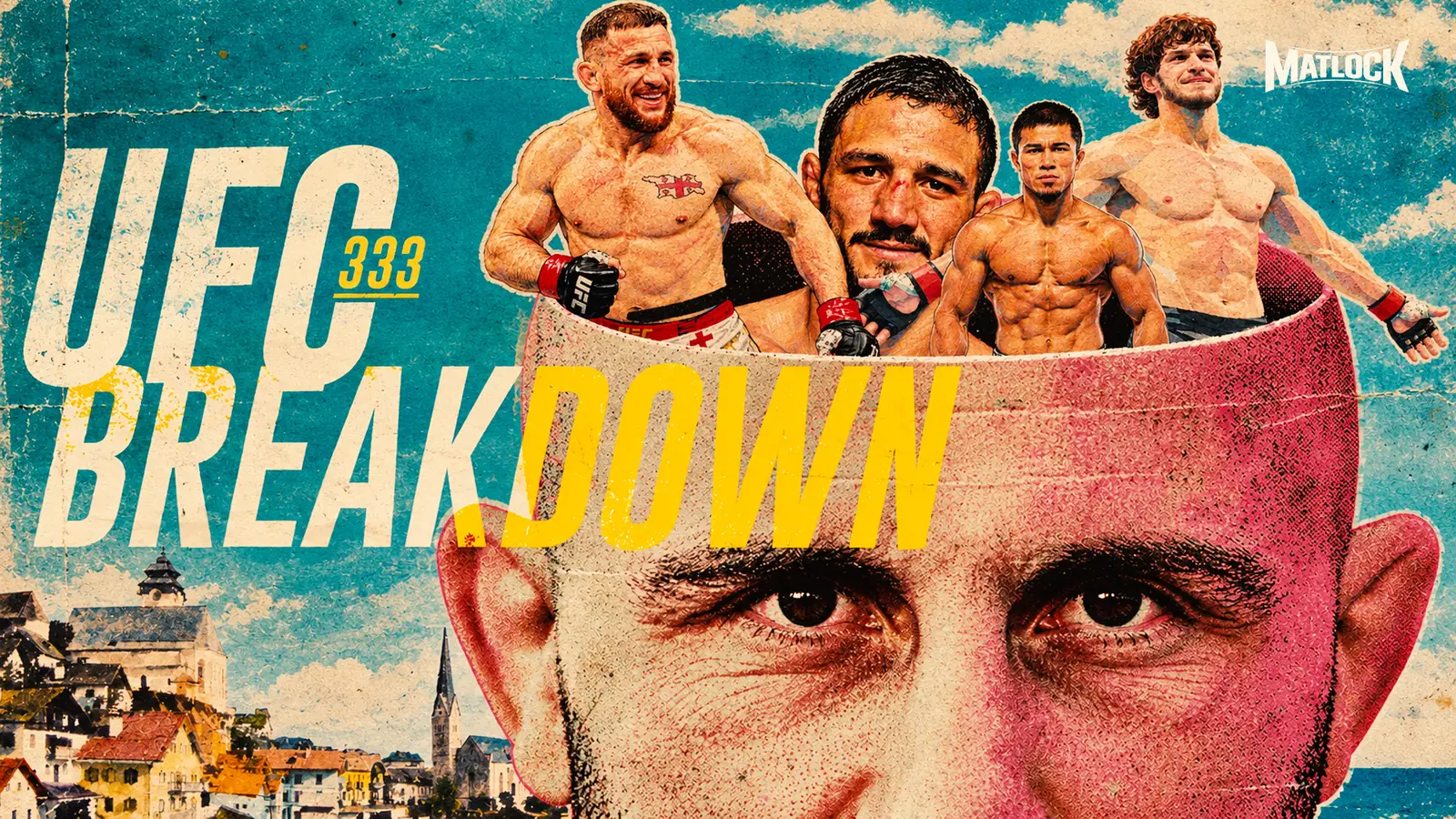
This card is stacked with really solid matchups. It seems I’m picking a lot of decisions but I think there is a lot of potential for super competitive fights. High stakes on this one.
As always, my picks are subject to change but they all be updated here and on Verdict where you can follow me! Breakdowns are done so those won’t change unless something happens throughout the course of fight week, in which case I’ll update.
Follow me on X for any updates, clips, and banter.
Alexander Volkanovski vs. Movsar Evloev


Alexander Volkanovski is a well-rounded, primarily orthodox striker who uses feints, footwork and changes in rhythm to set up his boxing and kicks. He has an excellent jab, mixes his attacks to the head, body and legs, and is particularly good at controlling distance and making adjustments as fights progress. He’s also a capable wrestler with strong takedown defense and plenty of five-round experience. After consecutive knockout losses to Islam Makhachev and Ilia Topuria, he bounced back with two wins over Diego Lopes.
Movsar Evloev is an undefeated, wrestling-heavy fighter with excellent conditioning and a relentless pace. He mixes his boxing with frequent takedown attempts, works well against the fence and is especially good at maintaining control through scrambles. His striking has improved considerably over the years, and he’s become more comfortable exchanging on the feet. He’s not much of a finisher, but his wrestling, cardio and overall consistency make him extremely difficult to beat.
I might have to eat crow on Saturday night.
I want to believe Volkanovski when he says he’s going to surprise everyone and get Movsar outta there early. He says he feels the best he’s ever felt, everything is clicking, and he’s confident he can get the job done. I just have a hard time seeing it play out that way.
Leading up to this fight, I’ve seen a lot of people suggest that Movsar’s wrestling will be the deciding factor, that we’re probably headed for a decision, and that if anyone gets knocked out, it’ll be Movsar. But after going back through Evloev’s recent fights, I think people are overlooking how much he’s actually willing to strike.
Even against Aljo, it was Sterling who initiated a lot of the wrestling exchanges. Movsar seems perfectly comfortable keeping fights on the feet, and he’s pretty damn good there, too. He has excellent timing on his jab, mixes in some sneaky stance switches, and I particularly like the inside body kicks he throws with his lead leg. Sometimes he gets a little too spinny for my liking, but he rarely gets himself into serious trouble doing it, so whatever. When he needs to secure a round, he can always fall back on his wrestling, but I don’t think that’s necessarily going to be his first approach here.
In fact, I wouldn’t be surprised if this fight spends considerably more time on the feet than people expect. And I think Movsar could have a lot more success in those exchanges than he’s being given credit for.
Now, you can break down all the X’s and O’s and make a pretty convincing case that Volkanovski is the superior striker. I wouldn’t disagree with that. But there’s a difference between what a fighter knows how to do and what he’s still physically capable of executing.
Watching Volk’s last couple of fights, I didn’t see quite the same reactions, timing, or even decision-making that made him so difficult to deal with in his prime. There are moments when he tries to execute something and it just doesn’t come together the way it used to. I suspect some of that comes down to losing a bit of the speed and explosiveness he once had.
I’ve noticed him shooting takedowns from too far out, leaving his head on the centerline, and occasionally neglecting his guard. These aren’t observations I’m pulling from his knockout losses, either. I’m seeing this stuff in the Diego Lopes fights, where Volk was largely successful.
And that’s what makes this matchup so interesting to me.
When I hear Volkanovski talk about Evloev, he sounds supremely confident that he’s the better fighter everywhere. I can understand why. On the surface, Movsar looks like a guy who does just enough on the feet, strings together takedowns, and controls people on the ground. He doesn’t come across as particularly dangerous because he isn’t finishing anybody. There isn’t a collection of knockouts or submissions you can point to. It’s decision after decision.
But I wonder if that perception could give Volk a false sense of confidence.
I think Volkanovski is an incredibly smart fighter who does his homework, so I’m not suggesting he’s overlooking Movsar. But I can see how he’d look at this matchup and believe he can overwhelm him with pace, volume, and pressure. Show him there are levels to this game. Why wouldn’t he be confident enough to wrestle with Movsar, too? Volk attempted takedowns against Diego Lopes, and Lopes himself managed to put Evloev in several submission attempts when they fought. Why would Volk risk that? I don’t know but he did.
I’m probably getting a little too deep into the hypotheticals here, but it ties into my bigger concern with Volkanovski.
I think he might attempt things against Evloev that he could’ve gotten away with four or five years ago, or even things he managed to get away with against Lopes. The problem is, I’m not convinced he’ll have the same margin for error against Movsar.
And I don’t think Volk necessarily needs to get outwrestled to lose this fight.
I expect Evloev to be extremely well prepared, and I genuinely believe he can hurt Volkanovski on the feet. Whether that’s enough to get a TKO or whether the damage just accumulates over the course of the fight, I don’t know. But I wouldn’t rule out a finish here, either. I rate Movsar’s striking higher than Diego Lopes’ or Yair Rodriguez’s.
The one thing that gives me pause is that Volkanovski has genuinely wanted this matchup. He hasn’t just reluctantly accepted Evloev as the deserving next contender. He’s pursued the fight because he likes it, and because beating an undefeated guy like Movsar would add another impressive chapter to his legacy. That’s worth considering. Volk knows what he’s looking at, and there’s obviously something about this matchup that makes him confident.
This is a fantastic fight with a hell of a lot at stake. If Volkanovski shows up and puts on one of those vintage performances, that would be incredible. I don’t think there’s a soul on this planet who would hate to see him win. Of course we want to see him win. He’s fucking badass and one of the greatest fighters to ever do the damn thing.
But as much as I’d love to see him prove me wrong, I have to go with what I’m seeing rather than what I’m hoping to see.
And right now, I see Movsar winning this fight.
Petr Yan vs. Merab Dvalishvili


Petr Yan is a technical, switch-stance boxer who likes to pressure behind a tight high guard, work his opponent’s body and legs, and put together combinations with excellent accuracy. He’s a patient striker who often starts slowly, studying his opponent’s tendencies before increasing his output. He’s also a capable wrestler with excellent takedown defense and good conditioning. After being thoroughly outworked by Merab Dvalishvili in their first meeting, Yan made some significant adjustments in the rematch, defending the majority of Merab’s takedowns and landing the cleaner, more damaging strikes to reclaim the bantamweight title.
Merab Dvalishvili is a high-pressure wrestler known for his incredible cardio, constant takedown attempts and relentless pace. He uses his striking to close distance, works well in the clinch and isn’t afraid to shoot repeatedly, even when his opponent is defending successfully. His striking can be sloppy at times, but he’s durable, physically strong and extremely difficult to keep off you. After winning 14 consecutive fights, including four successful title defenses, his streak ended against Petr Yan in their rematch, where he completed just two of 29 takedown attempts.
I’m leaning Yan here. Interestingly enough, in UFC trilogies where the series was tied 1-1, the fighter who won the rematch went on to win the third fight 8 out of 11 times. That’s roughly 73%. Obviously, it’s a small sample and not something I’d base my entire prediction on, but I thought that was pretty interesting.
I also genuinely believe Yan has Merab’s number now. The difference between their first two fights was pretty crazy. Merab landed 11 takedowns in their first meeting but managed just two on 29 attempts in the rematch. Yan actually took him down five times himself. I think Yan figured out how to deal with Merab’s wrestling, and I’m not convinced Merab can make enough adjustments to turn things around again.
That said, I don’t want to completely dismiss Merab. He had a ridiculous schedule in 2025, and I wouldn’t be surprised if the time off does him some good. He’s also had plenty of time to study what went wrong. I expect a competitive fight, probably closer than their last meeting, but I’m sticking with Yan. I think he wins another decision.
Lone’er Kavanagh vs. Ramazan Temirov


Lone’er Kavanagh is a fast, technical kickboxer with sharp counterpunching, quick reactions and a varied kicking game. He switches stances, moves well in and out of range and likes to catch opponents coming forward with quick combinations. He’s particularly effective with his low kicks and has good timing on his counters, although he can be caught with his hands down. His five-round decision win over Brandon Moreno showed his ability to follow a disciplined game plan against experienced opposition, while his submission loss to Brandon Royval raised further questions about his defensive grappling against the division’s better submission threats.
Ramazan Temirov is a short, explosive orthodox striker who fights aggressively, throws heavy punches and mixes in spinning attacks and kicks. He likes to pressure opponents, close distance quickly and throw powerful combinations, particularly hooks and overhands. He’s fast, physically strong and has some wrestling ability, although his aggressive approach can leave him open to counters. He’s 3-0 in the UFC, with first-round knockouts of CJ Vergara and Steve Erceg, along with a decision win over Charles Johnson that showed he can maintain his pace over three rounds.
Temirov is such a wild card. He’s a Tasmanian devil. He’s got an exciting style, but between you and me, I’m not that impressed. Sure, he’s explosive, well-rounded, powerful, durable, and technically sound enough to get by. But I think his aggression and PED use are attempts to compensate for the fact that he’s undersized compared to the rangier, more technical strikers in the division.
I think a lot of people are hesitant to pick Kavanagh despite the odds, and I get it. He suffered a brutal KO loss to Charles Johnson and a submission loss to Brandon Royval. Temirov loves throwing spinning attacks and launching missiles from another country, so Kavanagh’s sometimes lazy defense could get exposed again, just as it did against Johnson. He didn’t just get caught with his hands down while thinking he was out of range. Johnson also landed a spinning elbow earlier in the fight.
But if you go through Kavanagh’s last five fights closely, you’ll notice that he takes clean shots yet often recovers quickly and stays composed. Sometimes his opponent doesn’t recognize the damage, or sees too much risk in trying to capitalize. That’s because Kavanagh often remains balanced and prepared to absorb a shot in the middle of an exchange. In those situations, I actually think he has a very good chin.
Here’s where I’m at: I think Kavanagh is the better mixed martial artist, but I’m not sure he beats Temirov in an MMA fight. 😂 Temirov doesn’t follow the usual rhythms of an MMA bout. Fighting him almost feels like its own discipline. He’s a short, skittering ball of chaos, bouncing across the Octagon, throwing bombs and spinning kicks, and barely letting up for 10 straight minutes.
He reminds me of Merab, minus the relentless takedown attempts. Most opponents want to establish their jab, circle around the cage, and find their range. Temirov wants none of that. His striking accuracy is pretty poor, and that’s obvious when you watch his fights. But his relentless pace and explosiveness catch opponents off guard, and he has the power to hurt them or put them away.
I think the right fighter to beat Temirov needs to time him on the way in and intercept him with counters that use his forward momentum against him. He needs to lead Temirov into shots rather than react off his explosions. Combinations are important, too. His opponent has to be willing to take one to land three or four in return. Finally, he needs to invest in body work. If Temirov’s opponent survives the opening round, the goal should be to wear him down enough to take the second and third rounds or find a late finish.
Kavanagh might not be the perfect candidate, but he checks some of those boxes. His body kicks are excellent, particularly from southpaw. They could help him control the distance while baiting Temirov into thinking he has an opening, only to run into a straight left or check right hook.
Aside from Charles Johnson, I think Kavanagh is comfortably the best fighter Temirov has faced. With all due respect to Erceg, Kavanagh is also the more technically sound and intelligent fighter, at least when we set aside his defensive lapses.
Erceg leaned so far forward and stood so close to Temirov that it was bizarre. He barely used his reach or length to keep him at bay. Kavanagh can study Temirov’s fight with Johnson, giving him a shared opponent to analyze. I also think Kavanagh’s fight with Royval is very good experience to draw from because Royval pressed him relentlessly and stayed in his face. Can Kavanagh learn from that and not repeat those same habits?
Some of you are probably thinking, No way. Temirov is a freight train, and he’s going to blast through Kavanagh. Honestly, I can see that outcome just as clearly. Temirov’s style is dangerous, and Kavanagh has defensive flaws that could cost him dearly.
Still, I’m skeptical of Temirov, and I think Kavanagh has a genuine opportunity to win this fight. I’m not counting him out just yet.
Alexander Volkov vs. Rizvan Kuniev


Alexander Volkov is a tall, experienced heavyweight who fights primarily from an orthodox stance and makes good use of his height and reach. He’s a technical kickboxer with a solid jab, accurate straight punches and a varied kicking game, particularly his front kicks to the body. He fights at a fairly measured pace but stays active, puts together good combinations and has excellent conditioning for a heavyweight. His clinch work, takedown defense and offensive grappling have improved considerably over the years, making him a more well-rounded fighter than he was earlier in his career.
Rizvan Kuniev is a physically strong, orthodox heavyweight with a background in sanda and solid wrestling and grappling skills. He likes to pressure opponents, throw heavy punches and kicks, and work at close range, where he’s particularly effective with knees, uppercuts and clinch strikes. His striking isn’t always the cleanest, but he’s durable, has good conditioning and has shown excellent takedown defense against high-level wrestlers. He lost a competitive split decision to Curtis Blaydes in his UFC debut, then bounced back with a unanimous decision over Jailton Almeida and a third-round TKO of Tyrell Fortune.
Kuniev is going to try to feint his way inside Volkov’s range and work him against the cage. At range, I expect explosive straight punches to the body, leg kicks, and possibly uppercuts if he can get Volkov leaning in response to those body shots.
I think this fight could look similar to Volkov’s bout with Waldo Cortes-Acosta. Kuniev will look to close the distance and unload fast, heavy shots, while Volkov uses kicks and straight punches from range, circling out to avoid getting trapped against the cage. However, Kuniev seems to use more feints and fakes to set up his offense, and he’s more inclined to keep opponents pinned against the fence and work them over in the clinch.
That said, I think this could be a really close fight. Sometimes Volkov does just enough to get the nod, while other times it genuinely feels like the fight could go either way. I think he’d dominate outright if some of these fights were five rounds instead. 😂
Still, judging Volkov by his last performance, I don’t mind picking Kuniev here. He hasn’t faced particularly strong competition, served a suspension for PEDs, and hasn’t exactly looked spectacular. But he might have the right mix of skills to edge out a decision.
That said, this is heavyweight MMA, and anything can happen. I’m not going to die on the hill defending my Kuniev pick. Just look at Volkov’s body of work. The guy has an incredible résumé and sits all over the UFC heavyweight record books. I just think Kuniev might have a slight edge in this matchup.
Oh yeah, they were also training partners at one point.
Aaron Pico vs. Losene Keita


Aaron Pico is an orthodox fighter with an extensive amateur wrestling background and a powerful, aggressive boxing style. He likes to pressure opponents, throw hard combinations to the head and body, and use his explosiveness to close distance for takedowns. He’s particularly dangerous with his body punches and left hook, although his tendency to get overly aggressive has sometimes left him vulnerable to counters. After getting knocked out by Lerone Murphy in his UFC debut, he returned with a more measured performance against Patricio Pitbull, mixing his boxing and wrestling effectively to win a unanimous decision.
Losene Keita is a fast, explosive orthodox striker who mixes forward pressure with sharp counterpunching. He has quick hands, good footwork and likes slipping punches before firing back with two or three-punch combinations. He’s also good at catching kicks and uses hand fighting to set up his jab and follow-up punches. His speed and reactions are impressive, although he can be a little too willing to rely on them defensively. His takedown defense has been solid throughout his career, but he hasn’t faced much sustained wrestling pressure against UFC-level opposition. He lost a close split decision to Nathaniel Wood in his UFC debut before bouncing back with a first-round knockout of Muhammad Naimov.
Personally, I think this is a make or break fight for Pico. If Keita touches Aaron’s chin and he explodes into a million Picograms, that’ll be the end of me picking him again. If you see Keita at plus odds, you may as well take it. Nonetheless…
Keita is a fun fighter to watch. He likes to pressure, counter, and rely on his quick reactions and fast hands. He reminds me a bit of Michael Johnson in terms of speed, although Keita has a more varied shot selection. He’s also surprisingly good at catching kicks. Not every catch leads to anything significant, but he has some nasty follow-ups. He’s landed a left hook to the body off a catch and, in another sequence, held a kick and stomped his opponent’s knee. Brutal.
That said, I think his habit of reaching for kicks could come back to bite him if opponents start baiting him into it. I’d love to see someone sell a kick and throw a question mark kick over the top. Keita also struggles against low-line side kicks and oblique kicks.
Keita often uses his rear hand to control his opponent’s lead hand before throwing a power jab and following up with his right. He likes to slip or evade punches and fire back with quick two-punch counters. His takedown defense has held up reasonably well, and his conditioning looks solid, too.
However, like Michael Johnson, Keita struggles with striking accuracy. His timing and reads are there, but he often throws fastballs that miss the target or land without much precision. Obviously, that’s not always the case. He sent Naimov to the land of wind and ghosts, after all.
Keita looked stiff in his UFC debut against Nathaniel Wood, too. He wasn’t particularly fluid early on and only started to loosen up as the fight progressed. Even then, he was nowhere near as agile or mobile as usual. I suspect some of that was UFC debut jitters, but Wood deserves credit. He fought a disciplined fight, used plenty of feints, refused to fall for Keita’s usual tricks, and made him pay for his mistakes. Keita barely caught any of Wood’s kicks, if he caught any at all.
I also don’t think Keita did himself any favors in terms of optics. Several times, Wood’s punches fell short as Keita parried or moved out of range, only for Keita to immediately wipe the sweat from his face which I think made him look like he’d been hit. Keita sometimes leans just far enough away from incoming punches that they can look like they landed to the naked eye. In an incredibly close fight, I don’t think those reactions helped him.
I think a sharper striker with good footwork could give Keita problems. He moves in and out of the pocket reasonably well and times his counters, but when he commits to a punch, his face is there to be hit and his stance often squares up. Wood showed he could jab, take an L-step, and counter while leaving Keita out of position. Still, Keita is fast and tricky to hit cleanly.
Wood also did a good job timing leg kicks as Keita looked to explode off his lead leg, much like Costa did against Azamat Murzakanov. I bring that up because Azamat is on this card.
My assessment is that Keita is an entertaining action fighter with fast hands, creative combinations, and legitimate finishing ability. His power punches are dangerous, but he often sacrifices accuracy for speed and force. His defense is decent without being particularly reliable, and I think he’ll struggle against more formidable kickers and opponents with refined footwork. He’s shown decent takedown defense throughout his career, but I suspect a legitimate wrestler could exploit his explosiveness and put him on the mat. I haven’t seen enough to say definitively how good or bad that part of his game is.
Aaron Pico has been a difficult fighter to read. He’s got the skills and the raw materials, but they haven’t always come together cohesively. His style can look blocky and disjointed, and there’s often a sense of discomfort when watching him fight.
That said, his latest outing against Pitbull was arguably the best he’s looked. Yes, I know. Pitbull is 40, and there were moments when he just stared at Pico and let minutes tick off the clock. Still, Pico looked more comfortable on the feet and transitioned into his wrestling more seamlessly. That’s encouraging because he’s often looked uneasy or unsure, and that can lead to poor decisions.
Early in the Pitbull fight, Pico looked uncomfortable, reacting to everything and throwing heavy, looping punches alongside kicks launched from well outside range. As the fight progressed, though, he started working behind his jab and putting combinations together. That’s a positive development. It came later than many of us expected, but Pico is 30 now, and his game finally seems to be coming together.
The odds have this fight as a pick’em, and I think that’s fair. Pico needs to earn the trust of the fans and perhaps even himself. Keita is an exciting fighter coming off a highlight-reel knockout and a celebration that went viral. But what happens if he doesn’t find that fight-ending shot?
We got a glimpse of that against Nathaniel Wood, when Keita came away with a close split-decision loss. That fight played out entirely on the feet. Pico is going to make this an MMA fight.
Pico hasn’t always been effective at keeping opponents on the mat, and Keita has shown basic takedown defense. Even so, Pico has the tools to dictate where the fight takes place. I have plenty of questions about how Keita handles striking, grappling, and wrestling with his back against the cage. If Pico can work effectively at range, secure some takedowns, and make things ugly along the fence, he can take away Keita’s ability to operate in his preferred environment: open space.
Pico needs to stay composed, maintain his stance, and keep his feet underneath him. If he starts getting reckless or throwing himself out of position, he’ll leave himself open to Keita’s counters.
Looking at Pico’s striking, he can telegraph his shots and put so much windup and power behind them that he looks slower than someone like Keita. But when he’s building off his jab, he’s nearly as quick. Pico also varies his tempo more, whereas Keita tends to throw everything at the same high speed. I give Pico the edge in striking power, too.
Assuming his camp in Morocco has gone well and he’s getting quality work with the right training partners, I favor Pico to win. I think he can get it done by decision.
I’m really looking forward to this fight.
Azamat Murzakanov vs. Dominick Reyes


Azamat Murzakanov is a short, stocky southpaw with fast hands, good counterpunching and serious knockout power. He likes to pressure opponents, close distance with explosive combinations and attack the head and body with heavy hooks and straight left hands. Despite giving up height and reach to most light heavyweights, he’s effective at getting inside and has shown excellent takedown defense. He won his first six UFC fights, five by knockout, before suffering his first career loss to Paulo Costa, who stopped him with a head kick in the third round.
Dominick Reyes is a tall, athletic southpaw with good footwork, fast hands and knockout power. He likes to fight at range, using his straight left, counterpunching and a varied kicking game to attack the head, body and legs. He’s particularly effective when he can control distance, move in and out of range and catch opponents coming forward. He also has solid takedown defense and good conditioning, although his striking defense and durability remain concerns after several knockout losses. Following a four-fight losing streak, Reyes has won four of his last five, including knockouts of Dustin Jacoby, Anthony Smith and Nikita Krylov. His only recent loss came against Carlos Ulberg, who knocked him out in the first round.
I agree with the odds for this fight. Earlier in his career, I think Reyes would have smashed someone like Azamat with his speed, timing, and movement. He put together a phenomenal game plan against Jon Jones and executed it very well. He went through some tough fights and a notorious losing streak, but he has put together a respectable comeback despite his KO loss to Ulberg, who is now the champion.
Although Reyes has taken some clean shots in his last several fights, I’d still say his chin is suspect. I genuinely think a clean shot from Azamat Murzakanov could put him out. I think Dominick’s best path to victory is to take a few pages out of Paulo Costa’s playbook: hammer the kicks and keep moving. Reyes already has a pretty decent kicking game. His entire fight with Johnny Walker, for example, was practically a kicking match. I also favor Reyes to have the better conditioning. On top of that, he has simply faced better opposition. What’s even more hilarious is that Reyes is a year younger than Azamat.
Reyes is definitely a live dog here. I could see him winning by decision or getting a stoppage in the later rounds.
Another observation is that this is a southpaw vs. southpaw matchup. For what it’s worth, Dustin Jacoby did some of his best work against Azamat when he switched to southpaw. Could that benefit Reyes, who rarely switches stances and fights primarily from southpaw?
Paulo Costa had so much success with his kicks because of the open-stance matchup. He hammered Azamat with well-timed leg kicks as Murzakanov loaded his weight onto his lead leg to explode, knocking him off balance. Costa then attacked the body before going all-in on head kicks in the third round.
With all due respect to Reyes, I don’t think his timing is as good as Costa’s. I also don’t think he kicks as hard, or at least he hasn’t shown that same kind of power. On top of that, he isn’t primarily an orthodox striker.
That leaves me wondering whether Reyes can maintain his distance for three rounds without getting backed against the cage or caught by one of Azamat’s bombs. Murzakanov does well against taller fighters who like to kick and fight at range, as we saw against Rakic. To be fair, Rakic made some of the lowest-IQ decisions imaginable by repeatedly going for single legs against Azamat when he was doing perfectly fine at range.
Ribeiro was also having success at range, but Murzakanov’s ability to bounce on the balls of his feet, fire lightning-fast hands, and explode into his attacks eventually put him on his ass. Reyes has more to worry about than just the overhand. Azamat can attack the body and head with his jab, work in uppercuts, and land knees. He is especially dangerous in the first round.
I think Reyes has a real chance to win, but I can’t trust his chin, and I think his reactions have slowed. Also, he has bad striking defense in general. Hands down, chin up type of stuff.
But this is a fight he should win. Then again, we thought that about Blachowicz, Prochazka, Spann… he was favored in all those fights.
That said, I think it’s a close fight. If I have to weigh Azamat’s questionable cardio against Reyes’ questionable chin, I’m taking Azamat’s cardio. Not because his conditioning is horrendous, but because he noticeably slows down midway through the second round. He’s still dangerous and explosive, but if the fight reaches that point, things should become a hell of a lot less dangerous for Reyes.
I just don’t think we’ll see that happen. Azamat knocks out Dominick Reyes with a jab and the right hand follow up will just send him to the land of wind and ghosts before he hits the mat.
Nikita Krylov vs. Abdul-Rakhman Yakhyaev


Nikita Krylov is an experienced, well-rounded light heavyweight with a karate background, a varied kicking game and solid offensive wrestling. He fights primarily from an orthodox stance, likes to come forward with aggressive punching combinations and mixes in kicks to the head, body and legs. He’s also a capable grappler with good takedowns, ground-and-pound and a dangerous submission game. He’s finished 29 of his 31 career wins, although his aggressive style can leave him vulnerable to counters, and his defensive grappling has been inconsistent. He’s been knocked out several times in recent years, raising further questions about his durability.
Abdul Rakhman Yakhyaev is an explosive orthodox light heavyweight with a combat sambo background, powerful striking and a strong submission game. He throws heavy punches, mixes in kicks and is capable of taking opponents down and controlling them on the ground. He’s particularly effective at taking the back and finishing with rear-naked chokes. He’s undefeated at 10-0, with all three UFC wins coming in the first round, including an eight-second knockout of Julius Walker. Although he has gone five rounds earlier in his career, his UFC fights have been so short that it’s difficult to assess his conditioning and defensive weaknesses against better opposition. Nikita Krylov will be his most experienced opponent yet.
Yakhyaev has done a great job of overwhelming opponents with his speed and reaction time. Opponents have to be extremely careful about throwing lazy jabs or backing straight up because he’ll slip the shot and come over the top. He does it consistently. He’ll take the center, throw a big kick, wait for the response, slip the counter, and come back with a flurry of strikes.
The question is how well that translates against more experienced, well-rounded opposition. I still have serious questions about his wrestling against a fighter who can match him in that department. Luckily for Yakhyaev, high-level wrestlers are few and far between at light heavyweight. His lone amateur loss came against an opponent who outwrestled him, although that was seven years ago. We haven’t seen enough against formidable opposition in that area to know how much he’s improved.
There have been some interesting moments in his recent footage, too. Ribeiro landed a solid knee to the body as Yakhyaev blitzed into range, and he did well to avoid another rush and counter with a 1-2 while moving backward. . Yakhyaev appeared to panic and dive for an ankle on one takedown attempt.
He also leaned right into a head kick. Credit to him for trapping the kick, turning it into a takedown, and eventually securing the RNC. He’s explosive and dangerous, but there are openings to exploit if you can time his entries.
It’s kind of wild to see Krylov is only 34 because it genuinely feels like he should be older. I’ve been watching this dude since the beginning. 😭 He’s had a rough stretch, getting stopped by Reyes and Guskov before bouncing back with a buzzer-beater KO over Modestas Bukauskas, only to get stopped by Whittaker in his most recent fight. I’ll give him credit for absorbing Bukauskas’s shots, figuring him out, and finding the finish with practically no time left. He also made it into the third round against Whittaker before a jaw injury forced the stoppage. So I wouldn’t say his chin is completely shot, but there are legitimate concerns about his decline.
The question is whether he’s declined enough to lose to someone as inexperienced as Yakhyaev.
Stylistically, these two have some similarities. Krylov throws knees, kicks, and straight punches. He looks to slip and counter, and he’ll finish combinations with head kicks. The problem is how he handles pressure and movement going backward. Krylov often looks completely exposed while retreating in straight lines. He’ll throw counters when his back is against the fence, but he hasn’t consistently shown that he can defend himself effectively while moving backward in open space.
Those knees are worth watching, too. Krylov will throw them while standing on one leg, leaving himself vulnerable to counters. And perhaps most importantly, he gets countered off his own forward blitzes pretty often. That feeds directly into Yakhyaev’s game. If Krylov comes charging forward, he could give Yakhyaev exactly the openings he wants.
This fight might just be a car crash, and I can absolutely see a scenario where Krylov survives the initial onslaught. Will Yakhyaev’s explosiveness and speed be enough to get him out of there in the first round? Can he drop Krylov, pounce on him, and land enough ground-and-pound to force the referee to step in?
The odds suggest Yakhyaev is practically a lock. I agree that if these two crash into each other, Yakhyaev is the more likely man to walk away with the win, but I’m not buying him at -500. I don’t trust him that much. There are still levels to this game, even if Krylov hasn’t looked great lately.
If Krylov survives the first round, things could get interesting. He might settle in, make some adjustments, and maybe, just maybe, win the final two rounds. That’s a real scenario worth considering when you’re looking at a price this steep. I also would not at all be surprised if Krylov can set something up and sit Yahkyaev down.
As for the ground game, I really don’t know what to make of it. I’d expect Krylov to have enough experience to defend some takedowns or at least keep himself safe on the bottom, but experience doesn’t automatically translate to effective defense. I’m not sure how much success he’ll have offensively, either. Yakhyaev’s explosiveness and ability to capitalize on scrambles could make things difficult.
I’d genuinely like to pick Krylov here because I’m skeptical of Yakhyaev, but I can’t quite get there. I think Krylov will crash forward, and that could be exactly what Yakhyaev needs to land the counter that puts him away.
Still, I’m not comfortable laying -500 on an inexperienced fighter with unanswered questions against a veteran who, for all his flaws, has been in there with some of the best in the sport. I’m picking Yakhyaev, but I’m not convinced the price reflects the actual risk.
Believe me, I’ll be watching this fight closely, with my eye locked on those live odds. If Krylov survives the first round and starts finding his footing, I want to see what the market does.
Abus Magomedov vs. Cam Rowston


Abus Magomedov is a tall, rangy middleweight with an aggressive striking style and a solid wrestling and grappling game. He likes to pressure opponents with front kicks, straight punches and knees, and occasionally mixes in spinning attacks and other unorthodox techniques. He’s physically strong, carries good power and has become more willing to use his wrestling and pursue submissions. His biggest weaknesses are his striking defense and conditioning. He tends to leave himself open when attacking, and his pace can drop considerably as fights progress, particularly when opponents survive his early offense and force him to work defensively.
Cam Rowston is a tall, rangy orthodox middleweight who trains at City Kickboxing. He has good straight punches, a varied kicking game and uses his knees and front kicks effectively at range. He’s also a capable grappler with a solid submission background, particularly with rear-naked chokes. He’s comfortable working from top position and has shown some effective ground-and-pound. He’s 3-0 in the UFC, with stoppage wins over Andre Petroski and Cody Brundage, followed by a decision over Robert Bryczek. His earlier Contender Series loss to Torrez Finney exposed some weaknesses against persistent wrestling pressure, although he has looked more comfortable in grappling exchanges since then.
Abus is someone I almost want to root for because he occasionally shows some cool stuff on the feet, at least for a middleweight. He’s got that marching, high-knee style and some crafty, tricky striking techniques. His wrestling and grappling aren’t all that bad, either.
This is going to sound weird, and I promise I don’t have a foot fetish, but Abus has some oddly flexible feet that almost seem capable of gripping his opponent’s limbs. His feet can grab things! Just not in the normal direction 😂. I’m mostly joking. Mostly.
That being said, Abus has some awful striking defense and a tendency to gas out. If he can’t impose his will, he wilts. I’d have to assume those freakishly weird feet make running a difficult task for the man. Jokes aside, at his best, Abus is tough to kick and his pressure can be a lot to deal with. He carries serious power, but he’s certainly not immune to getting knocked out himself. And don’t let the Dagestani roots fool you. He’s been submitted, too.
I’m still unconvinced by Rowston at this point. He’s rangy and well-rounded, and he’s improving incrementally, particularly with his hands and, perhaps, his defense against incoming strikes. He does back up in straight lines at times, though, and while I think his wrestling and grappling are serviceable, he can struggle to maintain position or follow opponents on the mat. It’s hard to tell whether that’s improving when the level of competition he’s faced makes it difficult to judge. His height and reach have clearly been his biggest advantages, and learning to consistently land a solid one-two has done wonders for his game. He comes from a good gym, and his game planning has been fairly solid. Abus Magomedov should be a good test of where he’s at.
I think Cam Rowston’s most likely path to victory is a decision, with a late stoppage also possible. That projection relies heavily on the assumption that Magomedov will gas out. It’s worth remembering, though, that of the nine fights Magomedov has taken to a decision, he’s won seven unanimously and lost two unanimously. If I compare these guys at their best, I think Magomedov has the advantage in most areas. His game flows together more naturally, whereas Cam, despite looking more comfortable on the feet in recent fights, still seems to rely heavily on getting the takedown, establishing top position, and landing ground-and-pound. I don’t think he’ll have that same luxury here.
I was joking about Magomedov’s toes earlier, but there’s a legitimate point underneath the joke. Abus is more capable in the wrestling and jiu-jitsu exchanges than he sometimes gets credit for. He’s better at moving with his opponent and reacting to scrambles to secure better positions. Cam can look fairly flat-footed on the mat, and he doesn’t always use his feet actively to adjust his position or maintain control. Against certain opponents, that has cost him positions he’s worked hard to earn. It’s not necessarily a dealbreaker, but it’s another area where I think Magomedov could have an advantage.
I’m having a tough time imagining how this fight plays out because these guys are so similar in size. If Cam can keep things simple with meat-and-potatoes striking and movement, I think that’ll get him pretty far. Teeps, straight punches, and constantly keeping that jab in his opponent’s face. He’s already very good at that.
What gives me pause is his fight with Torrez Finney. I thought Cam was clearly the better striker, but he couldn’t get Torrez off him. It’s tough to draw any definitive conclusions from a weird fight like that, but it does make me wonder whether Magomedov can find similar success with pressure and control. If this fight makes it to the third round, that’ll be an interesting dynamic to watch.
There’s enough to like in Cam’s striking, but I haven’t seen enough to know how he’ll handle opponents who can take away his space and force him into uncomfortable positions. Based on what I’ve seen outside the UFC, on Contender Series, and in his UFC matchups so far, there are still too many unanswered questions for me to make a confident pick. Cam Rowston is a good pick simply because he’s not 36 and he isn’t a gasser like Magomedov. Skill for skill? I’d go with Abus Magomedov but on Saturday night… Cam Rowston.
Grant Dawson vs. Nurullo Aliev


Grant Dawson is a switch-stance lightweight who relies heavily on his wrestling, top control and submission grappling. He likes to pressure opponents toward the fence, work for takedowns and spend long stretches controlling them on the ground. He’s particularly good at taking the back, maintaining position and looking for rear-naked chokes. His striking is fairly basic, although he’s comfortable throwing punches to close distance and set up his wrestling. He has excellent conditioning and can maintain a high grappling pace over three rounds, but his striking defense remains a concern, having been knocked out by both Bobby Green and Manuel Torres. He bounced back from the Torres loss with a third-round submission of Mateusz Rębecki.
Nurullo Aliev is an undefeated orthodox lightweight with a wrestling-heavy style, good physical strength and excellent top control. He likes to pressure opponents toward the fence, work for takedowns and maintain position on the ground. He’s a patient grappler who generally prioritizes control over submissions or ground-and-pound. His striking is fairly basic, and he hasn’t shown much finishing ability at the UFC level. He’s 4-0 in the promotion, with all four wins coming by decision, most recently dominating Mike Davis with his wrestling. Against Grant Dawson, he’ll be facing another strong wrestler with excellent conditioning, making this an interesting test of his grappling and takedown defense.
Aliev does everything pretty well, but nothing I’ve seen has stood out as particularly great. He’s scrappy and dynamic enough offensively on the feet, with herky-jerky movement and feints from the outside that are reminiscent of Khabib Nurmagomedov. His striking defense leaves a lot to be desired, though, and he gets hit with his hands down quite frequently, regardless of what the striking stats say. I’ve also noticed he’s not particularly good at blocking body kicks. There are openings here.
He gets takedowns, but some of his shots are pretty ugly. None of his competition has been able to consistently thwart his attempts, although opponents have managed to stop him at times and get back to their feet from bottom. It’s not as though Aliev has a devastating ground game, but what he does has been effective. He’s also put himself in triangle attempts in a couple of different fights. He hasn’t faced anything he couldn’t escape or come particularly close to being submitted by, but it’s still worth noting.
His conditioning is pretty good, although I have questions about how he’ll hold up in a third round against someone who can maintain a high pace and pressure. He sometimes looks a little winded and slow, but when he’s fighting at his own pace and tempo, which he usually manages to do, he can get through fights without much trouble.
Grant Dawson loves forward pressure and likes to make fights ugly, ultimately looking to end up on top, do damage, or advance position to take the back. His standup game, in my opinion, is primarily built around kicks, and some of them are downright ugly. There are times when he throws nice ones, but more often than not, they’re extremely telegraphed, with plenty of windup. A fighter with sharper reads can stay out of range or counter them. The same goes for his hands. He throws big punches from well outside punching range and also likes to throw spinning shit, both punches and kicks. His best attributes are his forward pressure, conditioning, and well-rounded grappling and wrestling.
This is solid matchmaking because Dawson and Aliev have similar strengths. I think Dawson is the better overall grappler and could find submissions against him. Their wrestling is more competitive, and I’m particularly interested in seeing how they match up against the cage. At range, they’re both pretty bad, but I’d give Aliev the edge because there’s a little more form to his striking. At the very least, it’s not quite as messy, although it’s still ugly, if that makes sense. Both also tend to get drawn into slugfests in the pocket.
When I think about their striking at range, I don’t see much of an advantage for either guy. Dawson might have a slight edge through activity and landing nonsense shots to the arms, but he also has opportunities to land body kicks if he can set them up. Aliev has been targeted there before. At close range, I favor Aliev to land the better punches, although I’m not convinced they’ll be fight-ending shots. They’ll likely be cleaner and do more meaningful damage. Dawson’s best opportunities up close could come from collar-tie uppercuts and knees to the body as Aliev comes forward. Aliev hunches over quite a lot, especially when he’s winging punches to close the distance, so I see a big opportunity for Dawson to land knees.
More interesting are their takedown attempts from range, something both fighters do regularly. They dive for single legs and knee picks, and I think both can defend each other’s takedowns in open space. The better question is who has the superior timing and setups. I’d argue it’s nearly even here, and I find it difficult to make a confident call before fight night.
Against the cage, it’s a trickier matchup to assess, but I do think Aliev chains things together a little better along the fence. The difference is probably nominal. I could see them battling for position and ultimately nullifying each other.
However, if either man gets the other down, I think Dawson’s grappling could be the difference-maker. He’s more opportunistic with submissions, and Aliev has shown more susceptibility to them. Dawson has fourteen submission victories, after all.
The other side of that equation is Dawson failing to secure anything and spending too much time hunting for submissions at the expense of position. That’s essentially what happened in Aliev’s fights against Soleicki and Shem Rock. Both found good submission opportunities but couldn’t capitalize on them. Rock also wasn’t effective enough on the feet, and by the time the third round arrived, he was making terrible decisions trying to find a way to win. Aliev simply needed to secure top position again to take the decision. That same scenario could play out here. The difference is that Dawson is much more of a dawg and will bring the fight to Aliev with relentless pressure and some of the ugliest striking you’ll see.
Personally, I find this an incredibly tricky fight to pick. I can make a convincing argument for either guy. Dawson’s entire game should be coming together at this stage of his career, with his mentality, training, fight IQ, and skill development all maturing. In theory, this is when he should be at his most dangerous. He is, however, fighting in Abu Dhabi, so if this goes to the scorecards in a relatively close fight, it’s possible the judges could favor one fighter over the other, if you believe in that sort of thing.
For me, I’ll give Aliev a slight lean. He’s proven against grapplers that he can survive and work his way out of bad positions. He’s the better athlete, has the better standup game, even if only marginally, and is younger with less mileage on him. But don’t believe for a second that Grant Dawson can’t survive and thrive in the latter half of the second round and into the third, dig deep, and put his veteran experience to work against Aliev.
Dawson by submission or Aliev by decision are both perfectly reasonable picks for me.
Colby Thicknesse vs. Asaf Chopurov


Colby Thicknesse is an orthodox bantamweight who trains at Freestyle MMA alongside Alexander Volkanovski. He started wrestling at a young age and holds a black belt in Brazilian jiu-jitsu. He’s an active grappler who likes to work for takedowns, control opponents on the ground and look for submissions. His striking is still developing, particularly his defense, and he hasn’t shown much punching power at the UFC level. He lost his short-notice UFC debut to Aleksandre Topuria but bounced back with consecutive decision wins over Josias Musasa and Vince Morales, bringing his professional record to 9-1.
Asaf Chopurov is an undefeated bantamweight who trains at Sambo 34 and regularly works with Petr Yan. He’s a well-rounded fighter who primarily fights orthodox but can switch stances, using kicks, feints and forward pressure to set up his striking and takedowns. He’s a strong wrestler with good clinch work, excellent scrambling ability and a dangerous submission game, particularly when taking the back. His striking is still developing defensively, but he’s shown good power and finishing instincts. He’s 11-0 professionally with five knockouts and five submissions, all by rear-naked choke. A former UAE Warriors champion with two successful title defenses, he’s making his UFC debut against Colby Thicknesse after knocking out veteran Reece McLaren in just 63 seconds.
I think Chopurov probably runs through Thicknesse here. I wasn’t particularly impressed with Thicknesse against Aleksandre Topuria, and while he’s picked up two wins since then, I haven’t seen anything that makes me confident he can handle someone like Chopurov. I think Chopurov is the better wrestler, the more dangerous finisher, and probably the stronger guy physically, too.
Obviously, he’s making his UFC debut, so there’s still some uncertainty about how he’ll perform against better competition. I also don’t want to completely write off Thicknesse, who’s never been finished. But I just don’t see many advantages for him in this matchup. I think Chopurov overwhelms him early and gets him out of there.
Jacob Malkoun vs. Abubakar Vagaev


Jacob Malkoun is an orthodox middleweight with a wrestling-heavy style, good cardio and a high work rate. He likes to pressure opponents with his boxing, work his way into the clinch and look for takedowns, where he can maintain top control and land ground-and-pound. His striking is fairly straightforward, but he throws a lot of punches and has become more comfortable exchanging on the feet. He’s not much of a finisher, relying more on his pace, wrestling and positional control to win rounds. After nearly two years away from competition, he returned in 2026 with consecutive unanimous decision wins over Torrez Finney and Gerald Meerschaert, showing particularly effective boxing against Finney.
Abubakar Vagaev is an experienced orthodox fighter and former two-time ACA welterweight champion with strong wrestling, good takedown defense and a fairly measured striking style. He likes to work at range, throwing hard punching combinations and low kicks, but can also use his physical strength to control opponents in the clinch and on the ground. He’s more comfortable winning rounds through control than chasing finishes, with 20 of his 25 victories coming by decision. He made a successful UFC debut against Saygid Izagakhmaev, landing four takedowns and controlling much of the fight, although he appeared to slow down in the third round. He now moves up to middleweight to face Jacob Malkoun.
Not a bad matchup but I think it might be another middleweight stinker. Malkoun is a good wrestler and probably doesn’t get enough credit for how effective he can be, but I think Vagaev is a pretty tough stylistic matchup for him. Malkoun isn’t particularly dangerous anywhere, and a lot of his success comes from being able to consistently take guys down and control them. I’m not convinced he’ll have much success doing that against Vagaev, who I think is just the better overall fighter.
My only real concern is Vagaev moving up to middleweight and how his conditioning holds up. He slowed down in his UFC debut against Saygid Izagakhmaev, and Malkoun certainly has the cardio and persistence to make things interesting if Vagaev starts fading. Still, I favor Vagaev in the wrestling exchanges, and I think he has more to offer offensively. I wouldn’t be surprised if this turns into a pretty competitive, grinding fight, but I’m comfortable picking Vagaev.
Bolaji Oki vs. Daniel Santos


Bolaji Oki is an explosive orthodox striker with fast hands, good power and a high work rate. He likes to pressure opponents, throw quick combinations and mix his punches to the head and body. He’s particularly effective when he can dictate the pace and fight at his preferred distance, but his striking defense becomes less reliable when opponents pressure him and force exchanges. His wrestling and grappling have also shown some weaknesses. He’s gone 1-3 in his last four fights, including consecutive knockout losses to Mason Jones and Manoel Sousa. After five UFC appearances at lightweight, he’s dropping to featherweight for the first time against Daniel Santos.
Daniel Santos is an aggressive featherweight who trains at Chute Boxe Diego Lima alongside Charles Oliveira. He’s a high-volume striker who likes to pressure opponents with punching combinations, hard kicks, knees and occasional spinning attacks. He’s also a capable offensive wrestler who mixes takedowns into his striking and can control opponents on the ground. His biggest weakness is his striking defense, as he tends to absorb a lot of punches while pressing forward. His four-fight UFC winning streak ended in May 2026 when Dooho Choi stopped him with a body shot in the second round after Santos had a strong opening round.
There’s a pretty significant size difference here, and that might end up being the deciding factor. Oki has three inches in height and six inches in reach over Santos, which is quite a bit. I’m curious how the cut down to featherweight goes for him, though. If he makes weight comfortably and doesn’t look drained, Santos is really going to have to mind his p’s and q’s.
Santos was knocked out by my Superboy Dooho Choi, which is certainly a respectable loss, but Choi is also a bigger featherweight. I think Oki could give Santos some similar problems with his size and power.
I’m a bit conflicted because I genuinely think Santos is the better overall fighter. I like his aggression, his pace, and I think he has more ways to win. There’s probably some value in Oki as an underdog, and I wouldn’t be surprised if he pulls it off. Still, I’m going to reluctantly side with Santos here. Not particularly confident, though.
Kody Steele vs. Noah Gugnon


Kody Steele is an orthodox lightweight with a Brazilian jiu-jitsu black belt and an extensive competitive grappling background, including a world title in combat jiu-jitsu. He’s an aggressive submission grappler who is comfortable attacking leg locks, scrambling and working from his back. He’s also a capable puncher with four knockouts in eight professional wins, although his striking defense needs improvement. He absorbed a lot of clean punches in his UFC debut loss to Rongzhu, particularly when exchanging at close range. He bounced back in May 2026 with a first-round heel hook submission of Dom Mar Fan, bringing his UFC record to 1-1.
Noah Gugnon is an aggressive orthodox lightweight who trains at Bulgarian Top Team. He likes to pressure opponents, throw heavy punching combinations and mix in hard low kicks. He’s also a capable submission grappler, particularly when he can take an opponent’s back. All 10 of his professional wins have come by finish, with six knockouts and four rear-naked chokes. He made a successful UFC debut against Miloš Janičić, badly compromising his opponent’s leg with a low kick before securing a first-round submission in just 81 seconds. He’s an exciting prospect, but that brief appearance tells us very little about his conditioning, striking defense or how he’ll handle tougher UFC competition.
This might be a tough outing for Gugnon, who I don’t think will enjoy the same advantages on the ground against Steele. Kody is a BJJ black belt and just heel hooked Dom Mar Fan in his last fight. The guy is built like a tank, has some serious power in his hands, and is tough as hell.
My biggest concern with Steele is how much damage he absorbs. He took a beating against Rongzhu, and while his durability is impressive, I don’t think that’s something you can keep getting away with. Gugnon has finished all 10 of his professional wins, so he’s certainly dangerous enough to make Steele pay for those defensive lapses.
I actually think this could be a pretty competitive fight, and I wouldn’t be surprised if it comes down to who can win that third round. Gugnon might have the better moments on the feet, but I favor Steele in the grappling exchanges and trust his experience a little more. I’ll lean Steele here.
Iasmin Lucindo vs. Nicolle Caliari


Iasmin Lucindo is a young, physically strong orthodox strawweight with an aggressive striking style and solid offensive wrestling. She likes to pressure opponents with punching combinations, work her way into the clinch and look for takedowns, where she can control position and land ground-and-pound. She’s also a capable submission grappler, although her striking can be fairly straightforward and she sometimes struggles against opponents who can match her physical strength. She’s 5-2 in the UFC, with notable wins over Marina Rodriguez, Karolina Kowalkiewicz and Angela Hill. She hasn’t fought since August 2025 and will be returning from a layoff of more than 14 months.
Nicolle Caliari is an orthodox strawweight with a background in karate, Muay Thai and competitive Brazilian jiu-jitsu. She’s an aggressive striker who likes to press forward and throw combinations, although her defense leaves plenty to be desired. She’s also an active offensive grappler who looks for takedowns and submissions, particularly armbars and chokes. All nine of her professional wins have come by stoppage, with five knockouts and four submissions. After losing her first two UFC fights, including a TKO loss to Carli Judice, she picked up her first UFC victory by submitting Shauna Bannon with an arm-triangle choke in the third round. Her striking defense remains a concern, as she’s absorbing nearly six significant strikes per minute through three UFC appearances.
Caliari is a very frustrating fighter to watch. She’s had a tumultuous relationship with the sport of MMA, to say the least. It seems she’s finally gotten her weight issues under control after getting her implants removed, and she’s now fighting at strawweight, where she should be. More than that, though, her game hasn’t really developed significantly since her pro debut.
There are brief moments in fights where it seems like she has a grip on what she wants to do in the striking, only to ultimately abandon it, throw down, and crash into a clinch. She’s got power in her right hand, and her kicks aren’t bad either. But she struggles to adapt at range against someone who gets the better of her in the exchanges. Eventually, she’ll blitz forward, create a bit of chaos, and force a clinch, hopefully finding something else to work with from there.
Any fighter who can fight off the back foot, counter effectively, and has even a little ability to break from the clinch will give Caliari problems. She’s a very emotional fighter, and I’d be willing to bet she’s a nightmare to coach. That being said, she seems to have made some minor improvements to her throws and positioning on the mat, though I think that’s mostly because she’s finally fighting at the appropriate weight class. She’s also tough and can take an ass-whooping, as she showed against Judice. Here’s a compilation of Caliari throughout the years. The good, the bad, and the ugly.
Iasmin Lucindo is a BJJ player who excels on top and has made considerable strides with her striking over the years, particularly when it comes to landing heavy counters. She also has a fondness for jumping knees and spinning shit. Her footwork remains a work in progress; she’s borderline Cat Zingano from the waist down, although there’s been noticeable improvement. Lucindo carries some natural pop, which was likely aided by a few of those supplements she popped for.
Her fight IQ is pretty good, all things considered, and I reckon it played a major role in securing the decision over Marina Rodriguez, who couldn’t get out of her own way. If you had Rodriguez winning that one, Lucindo sits at 3-2 across her last five outings. She’s more than happy to let an opponent march forward and may even prefer it, given the opportunities to crack them with those clubbing counters.
In the clinch, she’s capable of tying opponents up and using her strength to maintain control until she can bring the action to the mat. Once there, her BJJ is patient and methodical. She’s perfectly content to sit in a position for minutes at a time, but the moment her opponent starts moving underneath her, she’ll use that opening to progress toward a more dominant spot, create openings for ground-and-pound, or work toward a submission.
This matchup has a good chance of turning into a slugfest. Neither woman is reluctant to step into the pocket and trade hooks. They’ve both spent time dealing with those spindly, rangy strikers, so this should offer a more entertaining change of pace.
Lucindo gets the nod from me in the power department, and she appears more conscious of distance and pressure on both sides of the exchange. Should things inevitably turn into a clinch-heavy wrestling match, I give her the edge there, too.
The wildcard is Caliari’s scrappiness. She’ll chase submissions, hunt for throws, and gladly trade leather in close quarters. Even if the odds are slim, she’s certainly capable of finding a clean shot or catching something on the ground. More plausibly, though, she’ll try to turn this into a messy, high-output affair, forcing Lucindo to keep working until fatigue and sheer volume give her a path to the scorecards.
Ultimately, I favor the younger, stronger, more composed fighter with the longer reach — who also happens to have been popped for steroids. A KO/TKO wouldn’t surprise me, as Lucindo could accumulate enough damage to put Caliari away. Still, this is MMA at 115 pounds so a decision is more likely but I think I’ll pick a Lucindo by stoppage.