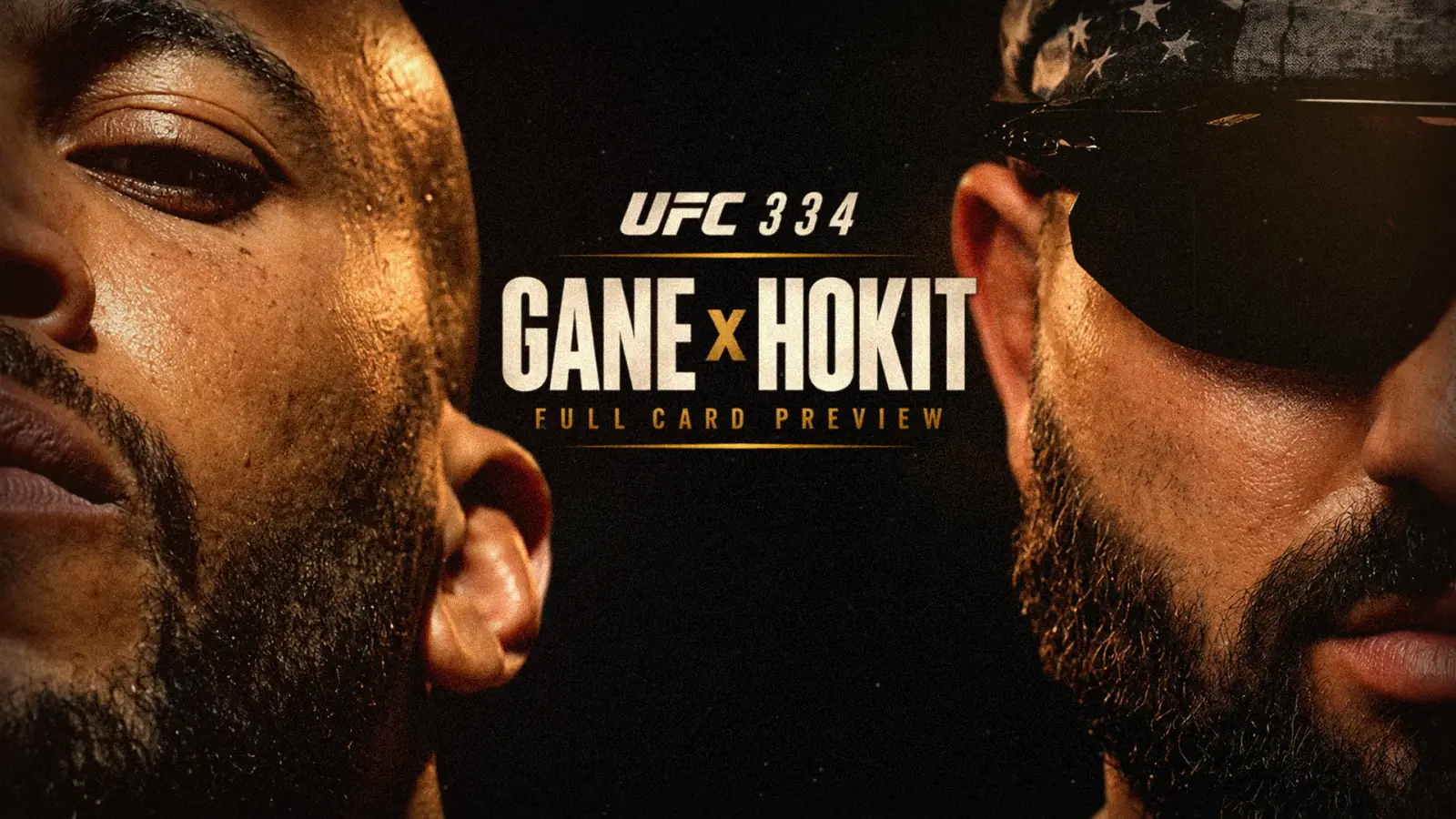
UFC 334: Gane vs. Hokit takes place Saturday, November 14, at Madison Square Garden in New York City. The early prelims begin at 5 p.m. ET, followed by the prelims at 7 p.m. ET and the main card at 9 p.m. ET. The card streams on Paramount+.
Ciryl Gane defends the heavyweight title against unbeaten challenger Josh Hokit in the five-round main event. The co-main pairs women’s bantamweight champion Kayla Harrison with returning former two-division champion Amanda Nunes. The card also features Caio Borralho against Yousri Belgaroui, Uroš Medić against Kevin Holland, and several matchups between established veterans and newer UFC names.
Card update (November 6): Nazim Sadykhov and Jefferson Nascimento both withdrew due to injuries. Adrian Yanez also announced his withdrawal from the Juan Diaz bout, although the UFC event page still lists the matchup. The original previews are preserved below as archived material, not active bookings.
Ciryl Gane vs. Josh Hokit


Ciryl Gane is a technically skilled heavyweight striker with a Muay Thai background, known for his footwork, speed and ability to fight from either stance. He uses feints, jabs, front kicks and low kicks to manage distance, often drawing opponents forward before stepping out of range and countering. Rather than standing his ground and trading heavy punches, Gane prefers to stay mobile, attack from different angles and gradually break opponents down with accurate, well-timed strikes.
Josh Hokit is a former collegiate All-American wrestler who has developed into an aggressive, high-volume heavyweight striker. He pushes forward, throws punches in long combinations and is willing to absorb shots to keep his offense going. Despite his wrestling credentials, Hokit has shown a preference for standing and trading punches, using his physical strength, relentless pace and durability to overwhelm opponents rather than relying primarily on takedowns.
Fight breakdown
I’ve been waiting for someone to blast through the UFC’s heavyweight division and get a title shot with relative ease because, I think most would agree, heavyweight isn’t exactly great right now.
So I had my eyes on two fighters, Josh Hokit and Gable Steveson. Gable Steveson got knocked out.
Looking at the heavyweight landscape, there aren’t exactly a lot of names that jump out at you. Tom Aspinall vacated, Poatan lost, and is the UFC really interested in doing a trilogy with Volkov? I mean, Volkov certainly has an argument for another title shot, but outside of a handful of fighters, how many heavyweights can the average fan even name?
Chill out, hardcores, I’m not talking to you.
Now, I’m very much a fan of Chael Sonnen’s school of promotion, and what Chael would say is that all someone has to do is raise their hand. Josh Hokit, love him or hate him, is that guy who called his shot and raised his hand.
By the time he fights for the undisputed heavyweight championship, he’ll have been in the UFC for just one year and six days, with four UFC fights under his belt, not including his Contender Series fight.
Josh Hokit did everything right.
Is this too much too soon for Josh, who only has 10 professional MMA fights? If it’s gonna happen in any division, it’s gonna be heavyweight.
And here’s something interesting. Ciryl Gane himself won the interim heavyweight championship against Derrick Lewis in just his 10th professional MMA fight. So it’s not like we haven’t seen a fighter with relatively little experience get to this level, especially in this division.
There’s a lot I like about Josh. He has a relentless pace, loves to pressure, has great conditioning, and from what we’ve seen so far, a pretty good chin and the ability to recover quickly. These are all amazing attributes to have in the heavyweight division because so many fighters are slow, plodding, low-volume guys.
Josh is pretty comfortable at range because you can tell he’s really confident in his speed and ability to get out of range of big shots. So he’ll do a bit of theatrics and feinting, using explosive movements from the outside to draw out an attack from his opponent.
He can let them hit air, or he can find an opportunity to counter. Both are excellent choices because some of these heavyweights are just throwing bombs, and it’ll gas them out.
We saw some of this against Derrick Lewis, who offered very little resistance to what Hokit was doing. Hokit was able to dictate the pace, find opportunities to attack, and even get some wrestling going. But Lewis wasn’t really forcing Hokit to make difficult adjustments, so I’m not sure how much that fight tells us about this matchup.
Sometimes Josh has good timing on his takedowns, but he doesn’t always get them. That isn’t necessarily a bad thing because he’s making these guys work. Even when he doesn’t secure a takedown, the threat of wrestling can make his opponents hesitant, and the clinch exchanges can be exhausting.
But there’s a difference between threatening takedowns, completing them, and actually keeping someone on the ground. I think that’s an important distinction to make in this fight because we haven’t really seen Hokit demonstrate that he can consistently take down and control someone at Gane’s level.
Against Blaydes, Hokit did well slipping the jab and countering, but not always. I think Blaydes felt pretty comfortable at range, thinking he was going to stick and move with the jab, and Hokit was able to read it, slip, and counter with his right hand over the top time and time again.
But the Blaydes fight also exposed some pretty significant defensive issues.
Hokit was getting hit a lot. Blaydes had success with his combinations, landed plenty of punches, and was able to find openings throughout the fight. Hokit showed an incredible chin, tremendous recovery, and the ability to fight through adversity, but being able to take a punch isn’t the same thing as being defensively sound.
And that concerns me against Gane.
Where Hokit really excels is putting pressure on his opponent, not giving them much room to breathe against the cage, and being relentless with his striking and grappling.
He really likes the one-two, loves throwing the right hand, and likes getting into the clinch, even if it’s to his own detriment. If he can’t get his opponent to back up, it’s often just jab-cross at range, trying to get his opponent to walk into his right hand, at least until he can find something with his wrestling.
And Hokit isn’t completely lost on the ground, either. He’s got submission wins on his record, including an armbar, and he even attempted one against Derrick Lewis.
But we have yet to see him in the UFC against a heavyweight with Gane’s combination of movement, distance management, and willingness to kick, and kick often.
Enter Ciryl Gane, who is, I think, the most athletic fighter and most sophisticated striker Hokit has faced.
Standing at 6’4” tall with an 81-inch reach, Gane has a three-inch height advantage and a seven-and-a-half-inch reach advantage. It’s going to be very interesting to see the dynamic between the two at range.
Gane is going to have to be more cautious about overcommitting to strikes and more mindful of his stance switches, as these are opportunities for Hokit to time his takedowns. And even though Gane has that reach advantage and is lighter on his feet, I think he still needs to be extremely mindful of Hokit’s speed.
Gane can get a little lazy with his defense at range when he thinks he’s out of range. Sometimes he doesn’t expect counterattacks, and when he exits after an exchange, that’s when he’s shown himself to be most vulnerable.
Some of this has been tightened up, but underestimating Hokit, no matter how small or inexperienced he is, would be a big mistake.
Gane isn’t the most defensively sound fighter in every exchange. He often pulls his head straight back when strikes are coming at him, and he doesn’t always get his head off the centerline when attacking. Again, some of this has been tightened up.
That being said, Gane is still the more defensively responsible fighter overall, and I think he’s far better at feinting and timing his jab, which I see being a struggle for Hokit.
I also think that if Gane can get the right reactions out of Hokit, he can really get his kicks going without too much risk of Hokit trying to catch them or close the distance while he’s throwing them.
And I think the kicking game is going to be especially important here.
Hokit wants to pressure, and he’s willing to eat shots to get into range. But there’s a difference between taking punches from Blaydes and having someone like Gane consistently attacking your legs and body while making you chase him around the cage.
If Gane can establish his jab, start working the legs and body, and force Hokit to constantly reset his entries, I think he can really start taking away some of what makes Hokit dangerous.
But that’s assuming Gane can establish his rhythm in the first place.
One thing I wouldn’t underestimate about Hokit is his ability to make a fight ugly. He doesn’t necessarily have to be the better striker or even the better wrestler to make things difficult for Gane.
He just has to stop Gane from getting comfortable.
If Hokit can consistently pressure him, threaten takedowns, and force him into clinch exchanges, even if those takedowns aren’t successful, he could make Gane hesitant to throw kicks or commit to combinations. Gane is at his best when he can dictate the range and choose when to engage. Hokit has the potential to make that pretty difficult.
And if Gane starts making mistakes under that pressure, Hokit is absolutely capable of capitalizing on them.
The more difficult aspect of this fight to anticipate is how well Gane is going to fare off his back against Hokit.
Gane has previously struggled to recover position and get back to his feet. Against Francis Ngannou, we saw him have difficulty dealing with the wrestling, particularly once Ngannou started implementing it later in the fight.
Against Jon Jones, there wasn’t really enough time to see how Gane would handle prolonged grappling exchanges because Jones finished him so quickly.
But I think the second Volkov fight is another interesting example.
In the third round, Volkov was able to get Gane to the ground, and Gane spent a considerable amount of time underneath him, holding onto a kimura attempt that wasn’t really getting him anywhere.
So was that an issue with Gane’s ability to escape, his decision-making, or both?
And would those same issues be present against someone like Hokit?
Gane is the larger man, and that could certainly help him in some of these exchanges. But I don’t think we should assume that because Hokit is smaller than some of Gane’s previous opponents, he’ll automatically have more difficulty controlling him.
Jones wasn’t significantly heavier than Gane when they fought, and that certainly didn’t stop him.
It’s more about whether Hokit can actually complete his takedowns, secure good positions, and prevent Gane from working his way back to his feet.
Tough to say.
We also have to consider how often Hokit can get this fight to the mat and how many times Gane can get back to his feet over the course of five rounds.
I think they both have pretty good conditioning, especially for heavyweight, so who’s going to be exerting the most energy? The one trying for takedowns and keeping the fight on the ground, or the one who has to consistently get back to his feet?
I think it may be more exhausting for Hokit to try to close the distance, cut off the cage, get through the strikes, and take Gane down, especially if Gane can get back to his feet and make Hokit try for it all over again.
But it’s not like Gane gets to recover for free.
He’s going to be spending energy circling, defending takedowns, fighting off the cage, and getting back to his feet. Even if he’s successful at defending all of this, that’s still a lot of work.
And if Hokit can hold him down for extended periods and keep his own efforts on the ground minimal through good positioning and weight distribution, the conditioning aspect of this fight could swing in Hokit’s favor.
I think the bigger question is whose style is going to force the other fighter to work harder.
Another thing to consider is that while Hokit has shown excellent conditioning over three rounds, we haven’t seen him do this over five. Gane has that experience, and I don’t think that’s something we should overlook.
At this point, I’m not sure Hokit can, or would even want to, keep Gane on the mat. He may be perfectly happy using the threat of takedowns to open up his striking and just make Gane work.
I also wouldn’t underestimate the Jackson-Wink camp and their ability to put together a really good game plan. And before you point to Gable Steveson and use that as an example of bad game planning from that camp, keep in mind that Jon Jones is not in the driver’s seat of Hokit’s career.
People are very divided on this fight, and I think a lot of that has to do with Hokit.
I’m leaning Gane here to get it done inside the distance.
I think if he’s disciplined for this camp, sticks to a game plan, minds his P’s and Q’s, and is able to recover from any low-IQ decisions he makes in the fight, he can work Hokit inside the Octagon.
Well-timed jabs and leg kicks are going to be extremely effective for Gane, and from there, he can set up his more powerful shots.
Hokit’s entries into range are going to be difficult, and I think this is where the striking defense we saw against Blaydes becomes a real concern.
Against Blaydes, Hokit was able to take a tremendous amount of punishment and keep coming forward. But I don’t think he can afford to fight that way against Gane.
Gane isn’t likely to stand in front of him and exchange punches for extended periods. He’s going to make Hokit work to get into range, and if he can consistently make Hokit miss, counter him, and get back out, that’s going to be frustrating.
And that’s really why I’m leaning toward a finish rather than a decision.
I think the accumulation of leg kicks, body kicks, and well-timed jabs could start slowing Hokit down, making his entries more predictable and forcing him to take bigger risks to get inside.
And as those entries become more desperate, the opportunities for Gane to land something significant are going to increase.
Now, Hokit has shown an excellent chin, and I don’t want to underestimate his ability to recover. But there’s only so much punishment you can take, especially against someone with Gane’s variety of attacks.
However, if Hokit can stay outside of Gane’s preferred range, find his timing on his takedowns to collapse that distance, work Gane against the cage with strikes, get him to the ground, and just really put Gane through a grind, betting on his conditioning to outlast Gane’s, then we might be in for another crazy fight.
And he doesn’t necessarily have to keep Gane on the ground to make that work. If he’s consistently disrupting Gane’s rhythm, making him defend takedowns, and preventing him from getting comfortable at range, that’s a pretty good start.
I think Hokit has a good opportunity to win this fight, but the Curtis Blaydes fight gives me a lot of hesitation about picking him.
What I liked about that performance was his toughness, pressure, and ability to keep fighting through adversity. What I didn’t like was how much offense he absorbed in the process.
And the Derrick Lewis fight, while impressive, didn’t really answer the questions I have about Hokit against someone like Gane.
I’m excited for this one. It’s a good heavyweight matchup, and I think we’re going to learn a lot about both fighters.
Give me Gane to get it done inside the distance.
Kayla Harrison vs. Amanda Nunes


Kayla Harrison is a two-time Olympic gold medalist in judo who has built her MMA career around physical strength, clinch work and dominant top control. She uses body locks, trips and throws to bring opponents to the ground, where she applies heavy pressure, advances position and attacks with ground-and-pound or submissions. Her striking is still developing and primarily serves to close distance and set up her grappling, where she is most dangerous.
Amanda Nunes is a former two-division UFC champion and one of the most accomplished finishers in women’s MMA history. She’s an explosive, heavy-handed striker who builds much of her offense around a powerful right hand, sharp boxing combinations and low kicks. Although best known for her knockout power, Nunes is also a Brazilian jiu-jitsu black belt with strong wrestling, effective takedowns and punishing ground-and-pound. She can fight aggressively when she senses an opening, but she’s equally capable of slowing things down, controlling position and winning rounds without relying on a finish.
Caio Borralho vs. Yousri Belgaroui


Caio Borralho is a well-rounded Brazilian middleweight and member of the Fighting Nerds team, combining a strong grappling background with a patient, technical striking style. He primarily fights from a southpaw stance, using feints, straight punches, kicks and lateral movement to control distance and create openings. A Brazilian jiu-jitsu black belt with a background in judo, Borralho is also an effective wrestler who uses explosive takedowns to establish top control, advance position and look for submissions. He’s a measured, adaptable fighter who is comfortable spending entire rounds on the feet or switching to his grappling when the matchup calls for it.
Yousri Belgaroui is a Dutch-Tunisian middleweight and former GLORY kickboxer who challenged for the promotion’s world title three times before transitioning to MMA. Standing 6’6”, he’s an experienced, technical striker who uses his height and reach to establish a stiff jab, punish opponents with low kicks and attack with knees when they close the distance. Belgaroui is particularly effective at breaking opponents down over several rounds, maintaining a steady output while accumulating damage rather than relying on a single knockout punch. He trains alongside Alex Pereira and Glover Teixeira, where he’s continued developing his wrestling defense and ability to get back to his feet.
Uroš Medić vs. Kevin Holland


Uroš Medić is a Serbian welterweight with an accomplished kickboxing background and some of the most dangerous finishing power in the division. A southpaw, he uses sharp combinations, straight left hands, hooks and powerful kicks to attack opponents at different ranges. He’s an aggressive, accurate striker who looks to hurt opponents early and rarely allows them time to recover once he has them in trouble. His biggest vulnerabilities have come in grappling exchanges, where stronger wrestlers have been able to control and submit him. Medić has finished all 14 of his professional victories, 12 by knockout or TKO.
Kevin Holland is a tall, unorthodox welterweight striker with an 81-inch reach, fast hands and a background in kung fu. He uses a long jab, powerful straight right hand, body kicks and unpredictable combinations to catch opponents at range, often relying on his timing and reflexes rather than conventional defensive technique. He’s also a Brazilian jiu-jitsu black belt with dangerous submissions, particularly his D’Arce choke, although his takedown defense and ability to escape sustained top control have been recurring weaknesses. Holland is known for talking throughout his fights, sometimes engaging in entire conversations with opponents while exchanging punches.
Bilal Hasan vs. Luis Gurule


Bilal Hasan is an undefeated flyweight striker with a third-degree black belt in Taekwondo, combining an unconventional kicking game with increasingly effective boxing. He switches stances, attacks the body and uses quick combinations and counterpunches to create openings for his power shots. Despite his Taekwondo background, Hasan has developed into a dangerous puncher, with eight of his ten professional victories coming by knockout or TKO. He’s also trained in wrestling and Brazilian jiu-jitsu, although his striking remains the strongest and most proven part of his game.
Luis Gurule is a pressure-heavy flyweight who relies on a high work rate, conditioning and physical strength to wear opponents down. He moves forward behind combinations and kicks, mixing in clinch work and upper-body takedowns when he gets close. He’s also a capable scrambler who is difficult to control on the ground. Gurule is at his best when he can maintain a steady pace and force opponents into prolonged exchanges, although his aggressive approach can leave him open to counters.
PRELIMS
Stephen Thompson vs. Charles Radtke


Stephen Thompson is a two-time UFC welterweight title challenger and former undefeated kickboxer with a distinctive karate-based striking style. He fights from a wide, sideways stance, keeping his hands low and using constant footwork, stance switches and quick changes of direction to stay out of range. His offense revolves around side kicks, roundhouse kicks, straight punches and sudden blitzing combinations, often catching opponents as they move forward or attempt to close the distance. Thompson relies heavily on timing, accuracy and movement rather than trading punches, although his unconventional stance can leave him vulnerable to takedowns and prolonged wrestling exchanges.
Charles Radtke is an aggressive welterweight who combines heavy-handed boxing with a Brazilian jiu-jitsu black belt. He likes to press forward, close the distance and throw fast, straight punches in combination, often looking to turn exchanges into a brawl where his power can make the difference. He’s also a capable grappler who can threaten submissions and take the back during scrambles, although he generally prefers to fight on the feet. His willingness to trade and limited head movement leave him vulnerable to counters, particularly against faster, more accurate strikers.
Drew Dober vs. Chris Duncan


Drew Dober is a veteran lightweight and former amateur Muay Thai champion known for his aggressive southpaw boxing and knockout power. He likes to pressure opponents into close-range exchanges, throwing hard straight left hands, hooks and body punches while mixing in low kicks. He’s particularly dangerous when countering in the pocket, where his timing and punching power allow him to hurt opponents even while taking damage himself. Dober is a durable, experienced striker who thrives in high-contact fights, although his willingness to trade leaves him open defensively, and opponents have found success against him through wrestling and sustained ground control.
Chris Duncan is a Scottish lightweight who combines aggressive, heavy-handed striking with an increasingly dangerous submission game. He likes to press forward, throw hard boxing combinations and low kicks, and force opponents into physical exchanges rather than fight cautiously at range. Since moving to American Top Team, Duncan has become a more versatile grappler, incorporating takedowns and developing a particular talent for front-headlock submissions, especially guillotine and anaconda chokes. His willingness to exchange makes him an entertaining fighter, but it also leaves him open to counters and defensive lapses, particularly against opponents with stronger positional grappling.
Jim Miller vs. Terrance McKinney


Jim Miller is a longtime UFC lightweight veteran with a wrestling background and a Brazilian jiu-jitsu black belt, known for his aggressive southpaw striking and dangerous submission game. He throws hard straight left hands, right hooks and inside leg kicks, often pressuring opponents into close-range exchanges where he can mix punches with takedowns. On the ground, he’s particularly dangerous during scrambles and transitions, attacking guillotine chokes, rear-naked chokes and armbars without needing to establish prolonged control. Miller is a physical, opportunistic fighter who is willing to absorb damage to create openings, although his forward pressure and willingness to exchange can leave him vulnerable defensively.
Terrance McKinney is an explosive lightweight with a collegiate wrestling background who fights at an unusually aggressive pace from the opening bell. He throws fast, powerful punches and head kicks, often rushing opponents with combinations before they can establish their offense. He’s equally dangerous on the ground, using his wrestling to secure takedowns, take the back and attack with chokes. McKinney has finished all 18 of his professional victories, 17 in the first round, but his all-out approach comes with significant risks. His stamina, defensive awareness and durability have been recurring problems when opponents survive his initial attacks.
Donte Johnson vs. César Almeida


Donte Johnson is an undefeated middleweight with an unusually short, powerful build for the division, standing just 5’8”. A southpaw with considerable knockout power, he fights aggressively, pressing forward behind heavy punches and looking to close the distance where his explosive combinations are most effective. He’s also physically strong in wrestling exchanges and has shown an ability to finish submissions, particularly the guillotine choke. Johnson has spent most of his young career finishing opponents early, although his three-round decision over Cody Brundage exposed some limitations in his striking technique and ability to maintain his offense over longer fights.
Cesar Almeida is a Brazilian middleweight and former GLORY kickboxer with an extensive striking background, including three kickboxing matches against Alex Pereira, one of which he won. He’s a patient, powerful counterstriker who uses low kicks, body kicks and sharp boxing combinations to manage distance and punish opponents for overcommitting. He’s particularly dangerous with his left hook, which produced a devastating knockout of Abdul Razak Alhassan in 2025. Almeida prefers to keep fights standing, where his timing and technical experience are most effective, although his defensive wrestling and ability to deal with sustained grappling pressure remain weaknesses.
EARLY PRELIMS
Jared Gordon vs. Melquizael Costa


Jared Gordon is a veteran lightweight with a boxing-heavy approach and a strong wrestling background. He fights at a high pace, constantly moving forward behind his jab, right hand and combinations to the head and body. He uses his pressure to force opponents against the fence, where he can work for single-leg takedowns and establish top control, favoring ground-and-pound over submission attempts. Gordon is particularly effective at wearing opponents down through sustained activity, although his willingness to exchange punches at close range has left him vulnerable to counters and knockouts.
Melquizael Costa is a Brazilian featherweight with a Muay Thai background and a Brazilian jiu-jitsu black belt, combining an unpredictable kicking game with dangerous submission grappling. A southpaw, he uses body kicks, low kicks, spinning attacks and sharp punching combinations to create openings, frequently changing his rhythm and attacking from unusual angles. He’s particularly dangerous with spinning back kicks, as demonstrated by his knockout of Dan Ige, but he’s also capable of taking fights to the ground and finishing with chokes or leg locks. His aggressive, creative approach makes him difficult to anticipate, although his willingness to throw elaborate techniques can leave him vulnerable to counters and takedowns.
Macy Chiasson vs. Bia Mesquita


Macy Chiasson is a tall, physical bantamweight who won Season 28 of The Ultimate Fighter and has developed into a strong clinch fighter and grappler. Standing 5’11”, she uses her length to throw straight punches and kicks before closing the distance, where she can press opponents against the fence, land knees and elbows, and work for takedowns. On the ground, she uses her size and strength to maintain top control, deliver ground-and-pound and attack submissions, particularly rear-naked chokes. She’s less comfortable in prolonged striking exchanges at distance, and stronger wrestlers have had success putting her on her back and limiting her offense.
Bia Mesquita is a Brazilian bantamweight and one of the most accomplished submission grapplers to transition into MMA, having won ten Brazilian jiu-jitsu world championships and an ADCC title. She’s an aggressive grappler who looks to close the distance, secure takedowns and advance quickly into dominant positions, particularly the back, where her rear-naked choke is a major weapon. She’s also effective at passing guard, maintaining top pressure and using ground-and-pound to create submission openings. Her boxing and wrestling are still developing as she adapts her grappling to MMA, but her technical advantage on the ground has already made her a dangerous finisher.
Evan Elder vs. Samuel Sanches


Evan Elder is an active, well-rounded lightweight who does most of his work on the feet, combining high-volume boxing with a varied kicking game. He uses his jab and straight punches to set up combinations, frequently attacking the body and legs with hard kicks. He’s comfortable exchanging at close range but can also counter effectively while moving backward. Although he has a wrestling background and some submission ability, including an arm-triangle choke finish in the UFC, his offense is primarily built around striking. His willingness to exchange and relatively vulnerable takedown defense can create problems against aggressive opponents.
Samuel Sanches is a Brazilian lightweight prospect and aggressive orthodox striker who has built his record around punching power and early finishes. He uses his reach to establish straight punches and low kicks before closing the distance with hard combinations, frequently mixing attacks to the head and body. Eight of his eleven professional victories have come by knockout or TKO, including a first-round finish of Chasen Blair on Dana White’s Contender Series in September 2025. He’s shown the ability to defend submissions and escape difficult grappling positions, although his takedown defense and tendency to leave his chin exposed remain concerns against stronger opposition.
Withdrawn bout previews
Adrian Yanez vs. Juan Diaz — withdrawn
Status: Yanez has announced his withdrawal. UFC.com still lists the matchup; the analysis below is retained for reference.


Adrian Yanez is primarily a boxer who gets a lot of his work done in the pocket. His combinations are quick and accurate, and he’s especially dangerous when he can counter an opponent moving into range. He’s coming off a first-round stoppage of Cody Garbrandt after fighting Ricky Simón to a draw earlier in the year. The concern has been how much he absorbs when opponents force longer exchanges or get to work on his lead leg. Against Diaz, he’ll want to keep the fight standing and make his boxing the deciding factor.
Juan Diaz arrives with a long stretch of wins behind him and experience going five rounds as LUX’s bantamweight champion. He mixes his striking with takedowns and submission work rather than relying on one phase of the fight. In his UFC debut, he submitted Malcolm Wellmaker in the second round after earning his contract with a spinning-elbow knockout on Contender Series. Yanez is a step up in boxing experience, so Diaz’s best opportunities may come from varying his entries and making Yanez defend more than punches.
Nazim Sadykhov vs. Jefferson Nascimento — canceled
Status: Both fighters withdrew due to injuries. This bout is not taking place at UFC 334.


Nazim Sadykhov is a southpaw lightweight who likes to put pressure on opponents and throw in combination. He does plenty of work at close range and has the power to finish exchanges, with eight of his eleven wins coming by knockout or TKO. His recent results have been rough, though: he was stopped by Farès Ziam in December and Matheus Camilo in June. He’s still capable of producing a high striking pace, but his defense has given opponents openings to hurt him.
Jefferson Nascimento built most of his record on the Brazilian regional circuit, including a run of title fights with LFA. He’s comfortable mixing strikes with grappling and has won by knockout, submission and decision. His UFC debut against Tahir Abdullayev ended in a third-round stoppage loss after he had won his previous four fights. The UFC sample is still only one bout, so it’s difficult to read much into his rate statistics. Against Sadykhov, staying composed under pressure and finding opportunities to change levels will matter.